Survival · Thursday, October 8
Bleach has a dose. Eyeballing it is how people get sick.
Unscented household bleach, the right strength, a clean container, and time. Write the recipe on the bottle.
by: Andrew, Co-Founder at Blackout Briefing
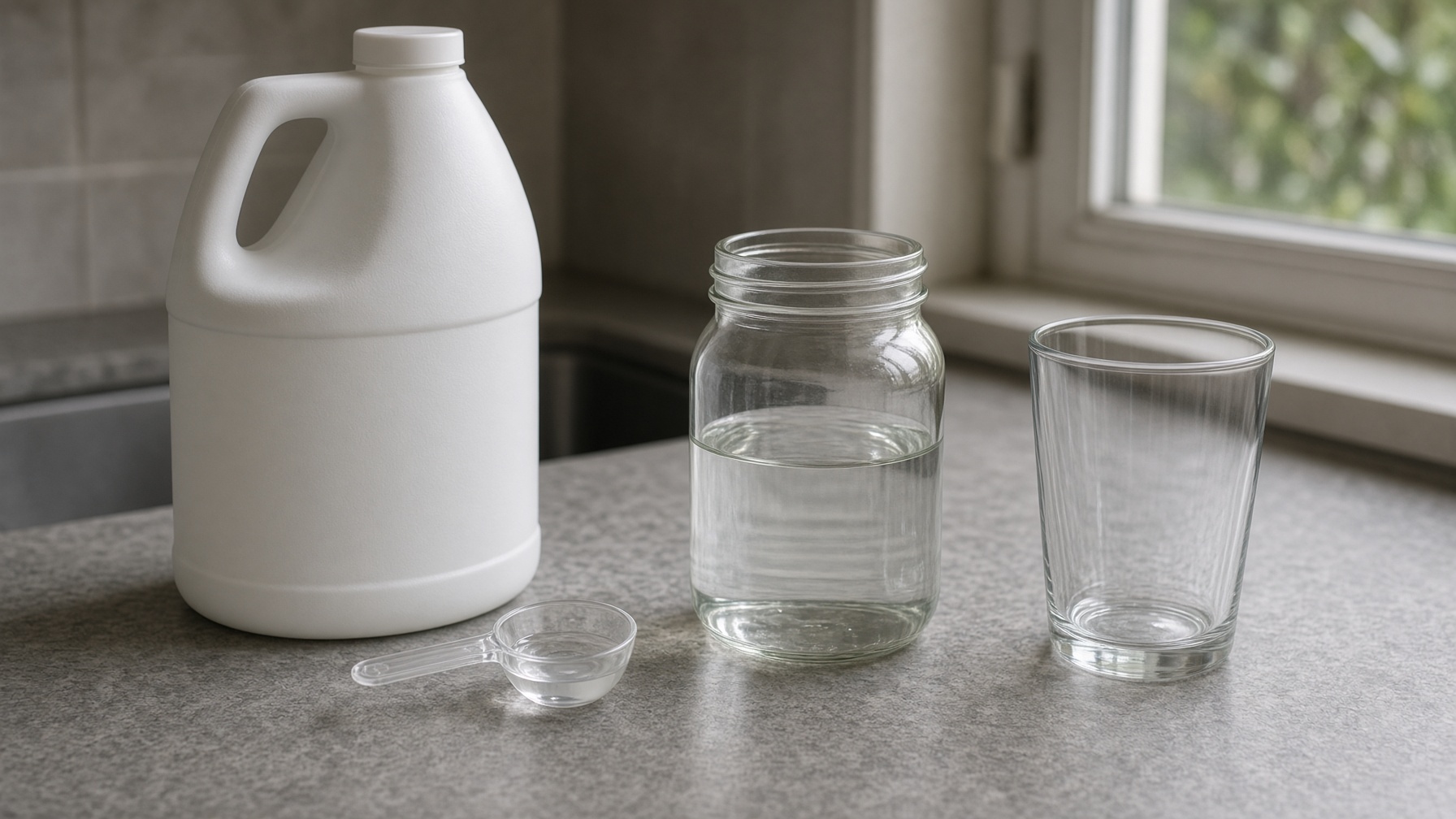
If stored water runs out, treatment is a recipe, not a vibe. Public-health guidance for unscented bleach is specific to the concentration on the label — the common one is on the order of a few drops per quart, then wait. Pool shock and scented cleaners are not substitutes. Boiling, a rolling boil for a minute, is the method that does not require you to remember a number.
The label is the recipe, because bottles are not all the same strength. A count remembered from a different jug is how a careful person still gets the dose wrong. Write the drops, the volume, and the wait on the bottle you actually have, in a form that does not require a charged phone to read.
The container has to be clean. A dirty jug spends the dose on the jug. Very cloudy water is not the same problem as clear water from a tap you have stopped trusting. Strain what you can. Do not expect the household recipe to finish a ditch.
Filters have limits. Chemical pollution and salt are not what a camping filter is for. Know your actual water source.
If the source is a flood beside a chemical smell, or anything you would not have used before the lights failed, boiling and bleach are the wrong tools. They are for the biological problem in otherwise ordinary water. Knowing the source is the step that says stop and find a different supply instead of treating poison as if it were a germ.
Do not improve the water by mixing bleach with other cleaners. That is a separate way to get sick, and it does not make the dose more serious or more correct. Unscented household bleach goes in alone, at the written strength, for the written time.
Practice once. The middle of a blackout is a bad time to discover you bought splash-less bleach that does not disinfect. Water stored ahead of time is how you avoid performing the recipe thirsty. The labeled bottle is the backup, and a backup you have never read is still just a bottle.
Sources
- Making Water Safe in an Emergency — Centers for Disease Control and Prevention · the article this brief was written from
- Build a Kit — Ready.gov / FEMA
- Electromagnetic Pulse and Geomagnetic Disturbance — Cybersecurity and Infrastructure Security Agency
More in Survival
- The first seventy-two hours are a sequence, not a vibe
by: Andrew, Co-Founder at Blackout Briefing
- A three-day kit is the opening bid, not the whole plan
by: Andrew, Co-Founder at Blackout Briefing
- Seven days in, the problem is information as much as calories
by: Andrew, Co-Founder at Blackout Briefing
Recent news
EMP
The civilian grid is still the soft target in a high-altitude pulseby: Andrew, Co-Founder at Blackout Briefing
CME
A Carrington-class storm is a when, not a science-fiction ifby: Andrew, Co-Founder at Blackout Briefing
Grid
Metcalf still explains the grid better than most white papersby: Andrew, Co-Founder at Blackout Briefing