EMP · Monday, October 19
The civilian grid is still the soft target in a high-altitude pulse
Military systems have been hardened in pockets. The transformers that feed homes, hospitals, and water plants have not.
by: Andrew, Co-Founder at Blackout Briefing
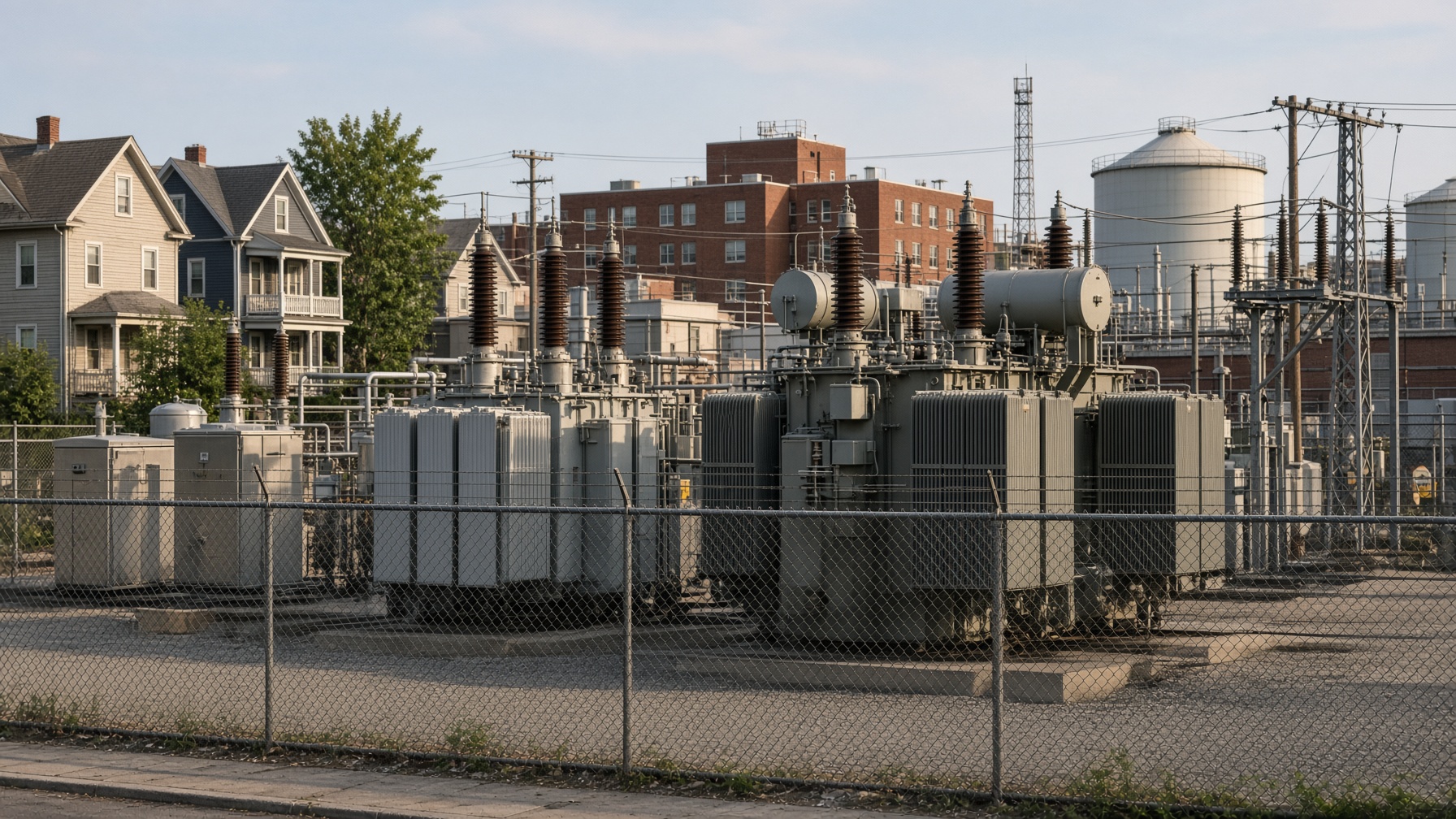
A nuclear detonation high above the continent would not need to level a city to stop modern life. The pulse it throws — the early E1 spike, then the slower E3 heave — couples into long conductors. Transmission lines become antennas. Extra-high-voltage transformers saturate, heat, and in the worst cases fail in a way that cannot be patched with a truck roll.
Saturation is the plain version of that failure. A transformer is built for alternating current. The slow heave biases it with a current that does not reverse, the core leaves the range it was designed for, and the machine heats. It does not have to rupture to be finished. It has to be damaged past anything a crew can patch on site.
Defense networks and some command sites have spent years on shielding, filtering, and spare parts. The civilian bulk-power system has not kept the same pace. Large transformers are built to order, often overseas, on lead times measured in months to years. A handful of simultaneous failures in one interconnection would strand regions even if most of the country still had voltage.
A shielded command post does not scale by comparison. It is one site, with a fence, a mission, and a budget that can live with idle spares. The civilian bulk system is a spread of yards under different owners and different regulators. The soft target is that gap in buying habits: equipment ordered overseas, on a clock of months to years, that a hardware aisle cannot replace.
Blackout Briefing’s view is narrow and practical: the argument is no longer whether an electromagnetic pulse is physically real. Starfish Prime and decades of simulator work settled that. The open question is how many unprotected nodes sit between a rare event and a blackout that outlasts the food in a refrigerator.
A region can be dark beside a region that still has voltage. Power between them moves on a limited set of ties. If the failed machines are those ties, or the transformers just behind them, the live neighbor cannot push useful power across the break. The outage is joint failure, not a uniform national switch.
The refrigerator is a duration test. Unsafe food is a matter of hours. A built-to-order transformer is not. Water pressure, fuel delivery, pharmacy resupply, and a city’s ability to learn what happened all depend on the unprotected nodes in between. The open question is how many of those nodes there are.
Sources
- How Top Trump Officials Stoked Fears of a Nuke That Could Fry the Power Grid — The New York Times · the article this brief was written from
- Electromagnetic Pulse and Geomagnetic Disturbance — Cybersecurity and Infrastructure Security Agency
- Executive Order 13865 — Coordinating National Resilience to Electromagnetic Pulses — The American Presidency Project
- Coordinating National Resilience to Electromagnetic Pulses — Federal Register
More in EMP
- E1, E2, and E3 are not the same problem wearing three names
by: Andrew, Co-Founder at Blackout Briefing
- Congress keeps using the phrase blackout warfare. The hardware has not caught up.
by: Andrew, Co-Founder at Blackout Briefing
- High-power microwaves are a battlefield tool. They are not a national blackout.
by: Andrew, Co-Founder at Blackout Briefing
Recent news
CME
A Carrington-class storm is a when, not a science-fiction ifby: Andrew, Co-Founder at Blackout Briefing
Grid
Metcalf still explains the grid better than most white papersby: Andrew, Co-Founder at Blackout Briefing
Survival
The first seventy-two hours are a sequence, not a vibeby: Andrew, Co-Founder at Blackout Briefing