CME · Monday, October 19
A Carrington-class storm is a when, not a science-fiction if
The 1859 event is the benchmark. A near-miss in 2012 showed the sun still throws storms of that size.
by: Andrew, Co-Founder at Blackout Briefing
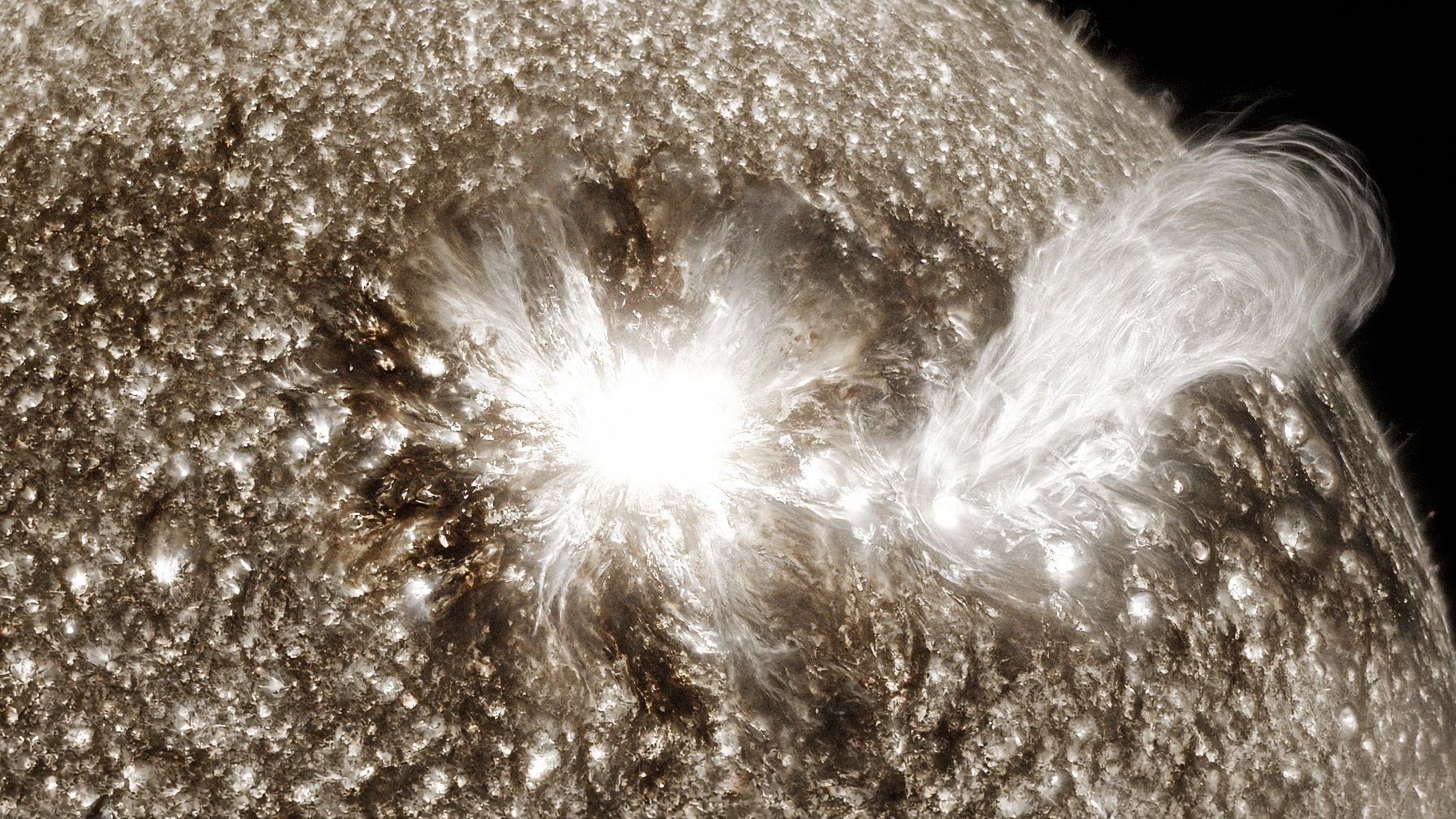
In September 1859 a coronal mass ejection hit Earth hard enough to set telegraph paper on fire and paint auroras down to the tropics. The same physics still applies. A fast CME compresses the magnetosphere, the ground electric field rises, and quasi-direct current flows through any long grounded conductor — including the high-voltage grid.
The telegraph network was the long conductor of that century: wire, batteries, and operators who found themselves in the circuit. The grid is the long conductor now. Quasi-direct current is a problem because the transformers at each end were built for current that reverses many times a second. The fire in the telegraph office and the heat in a modern unit are the same coupling in different metal.
Lloyd’s and several national labs have modeled the economic hit from a modern Carrington-scale storm in the trillions, mostly because damaged transformers are not stocked like poles and wire. The often-cited annual odds of a storm that large sit near one percent. That is not a panic number. It is a planning number: over a few decades the cumulative chance stops being negligible.
The economic estimates are large mostly because the scarce object is slow to replace, not because the storm itself lasts. Poles and wire are stocked. An extra-high-voltage transformer is ordered, built, and moved. The disturbance can be finished while the replacement queue is just starting. That queue, not the aurora, is what stretches a blackout.
Operators already have a tool the telegraph era lacked: hours of warning from satellites watching the sun. Warning only helps if someone is authorized to open lines, shed load, and park vulnerable equipment before the shock arrives.
An annual chance near one percent is a reason to buy spares and to write the authority to act. It is not a date. The chance refreshes for as long as the grid stays built this way. Over a few decades, “unlikely this year” stops being a reason to skip the plan.
Opening lines, shedding load, and parking vulnerable equipment all cost something on a normal afternoon: interrupted service, complaints, and the chance the storm glances off. A control room that can take those steps only after a fresh debate will spend the satellite’s warning inside the debate. The unfinished piece is permission and practice, not another sensor.
Sources
- Solar Storm Risk to the North American Electric Grid — Lloyd’s · the article this brief was written from
- NOAA Space Weather Scales — NOAA Space Weather Prediction Center
- Space Weather: Policy and U.S. Government Roles (CRS R46049) — Congressional Research Service
More in CME
- G2 is a nuisance until it is pointed at the wrong transformer
by: Andrew, Co-Founder at Blackout Briefing
- Quebec, 1989, is still the cleanest warning the grid has
by: Andrew, Co-Founder at Blackout Briefing
- The 2012 storm missed Earth by about nine days
by: Andrew, Co-Founder at Blackout Briefing
Recent news
EMP
The civilian grid is still the soft target in a high-altitude pulseby: Andrew, Co-Founder at Blackout Briefing
Grid
Metcalf still explains the grid better than most white papersby: Andrew, Co-Founder at Blackout Briefing
Survival
The first seventy-two hours are a sequence, not a vibeby: Andrew, Co-Founder at Blackout Briefing