Survival · Friday, October 16
Cold is the casualty people underestimate in a winter blackout
Pipes, then people. A plan that assumes you will “just go to a hotel” assumes the hotel has power and roads.
by: Andrew, Co-Founder at Blackout Briefing
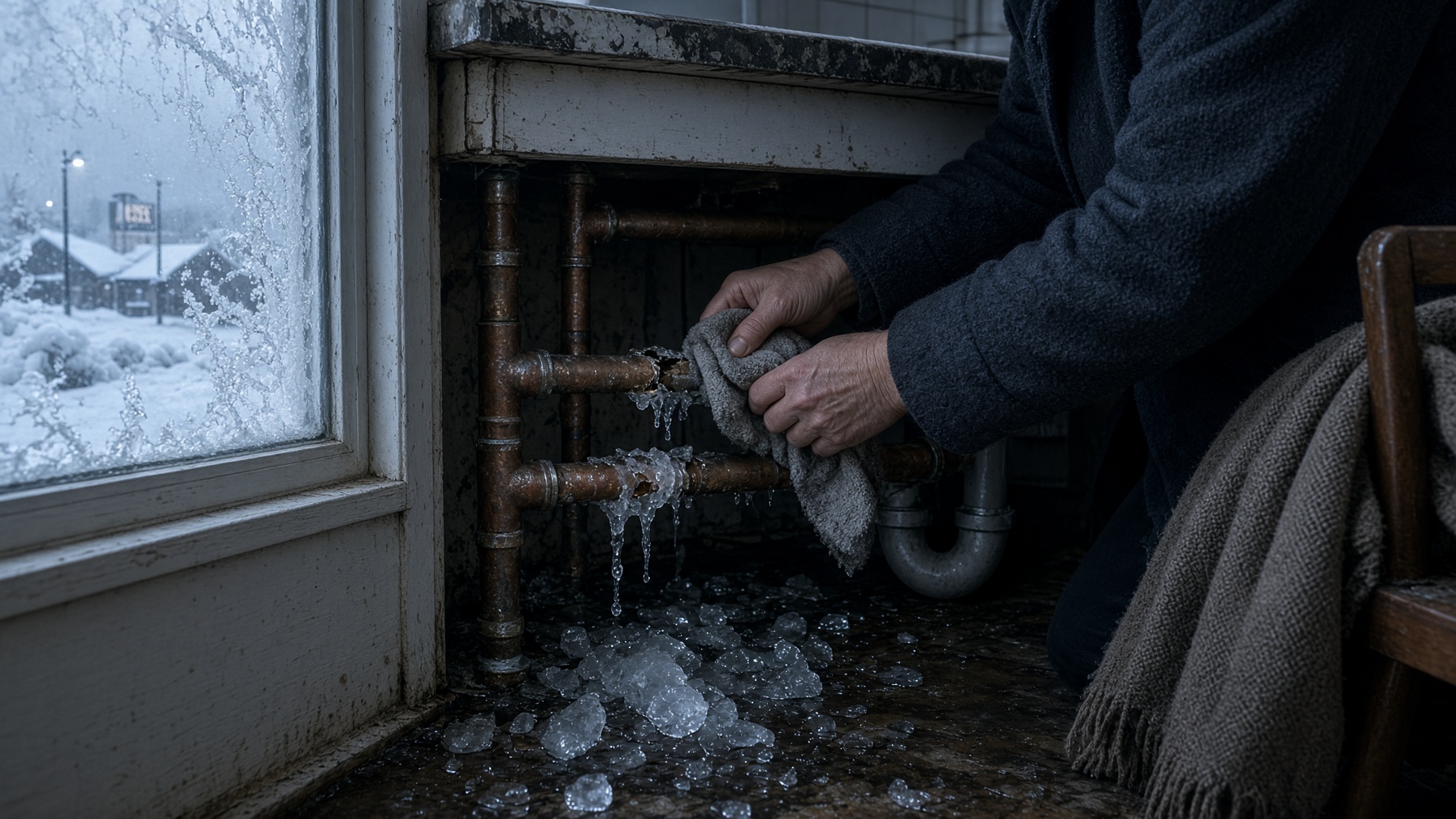
In a winter grid failure the clock is heat. A house loses temperature faster than most families expect, especially a modern one built around a furnace blower. Pipes freeze next, and a flood on day three is a miserable way to learn the sequence.
Many modern furnaces only deliver heat while a blower and its controls have electricity. Fuel in a tank does not become a warm room by itself. A house built around that blower loses its heat faster than families expect, because the building was never designed to stay livable on body heat and a closed door. Know whether your heat needs an outlet before you count on the thermostat.
The low-tech layer still works: one room, closed doors, dry layers, a sleeping bag rated for the actual night, and a carbon-monoxide alarm if any combustion is involved. Never run a generator or a charcoal grill indoors. That rule is older than this newspaper and still gets ignored.
Frozen pipes are the second casualty, and they often announce themselves as a flood once any warmth returns. A flood on top of a blackout ruins stored food, medicines, and the rooms you were trying to keep. If you can safely shut water off to the parts of the house you cannot protect, that step belongs on the same page as the heat plan. Learn it before the night, not during it.
Know a warmer place that does not depend on your car starting — a neighbor with a wood stove, a family member in the same town. Distance is a liability when signals and fuel are both short.
One room is the tactic. Heat people, not unused floor space. Closed doors, dry layers, and a sleeping bag rated for the night you actually get will outperform a plan to keep the whole house normal. Damp clothing steals heat. A carbon-monoxide alarm stays in the room if any combustion is involved. The indoor generator and the indoor charcoal grill are still how that plan kills people.
A hotel only works if the hotel has power, the roads work, and the car starts. Those are three bets, and a wide winter outage is a bad time to make all three. A neighbor with a wood stove, or family in the same town, is a place you can reach without a trip. Ask before the cold season. Distance is expensive when fuel and signals are both short.
Sources
- Power Outages — Ready.gov / FEMA · the article this brief was written from
- Build a Kit — Ready.gov / FEMA
- Electromagnetic Pulse and Geomagnetic Disturbance — Cybersecurity and Infrastructure Security Agency
More in Survival
- The first seventy-two hours are a sequence, not a vibe
by: Andrew, Co-Founder at Blackout Briefing
- A three-day kit is the opening bid, not the whole plan
by: Andrew, Co-Founder at Blackout Briefing
- Seven days in, the problem is information as much as calories
by: Andrew, Co-Founder at Blackout Briefing
Recent news
EMP
The civilian grid is still the soft target in a high-altitude pulseby: Andrew, Co-Founder at Blackout Briefing
CME
A Carrington-class storm is a when, not a science-fiction ifby: Andrew, Co-Founder at Blackout Briefing
Grid
Metcalf still explains the grid better than most white papersby: Andrew, Co-Founder at Blackout Briefing