Survival · Friday, October 16
Fuel discipline decides who still has a generator on day four
A generator without a runtime budget is a noisy way to burn next week’s options tonight.
by: Andrew, Co-Founder at Blackout Briefing
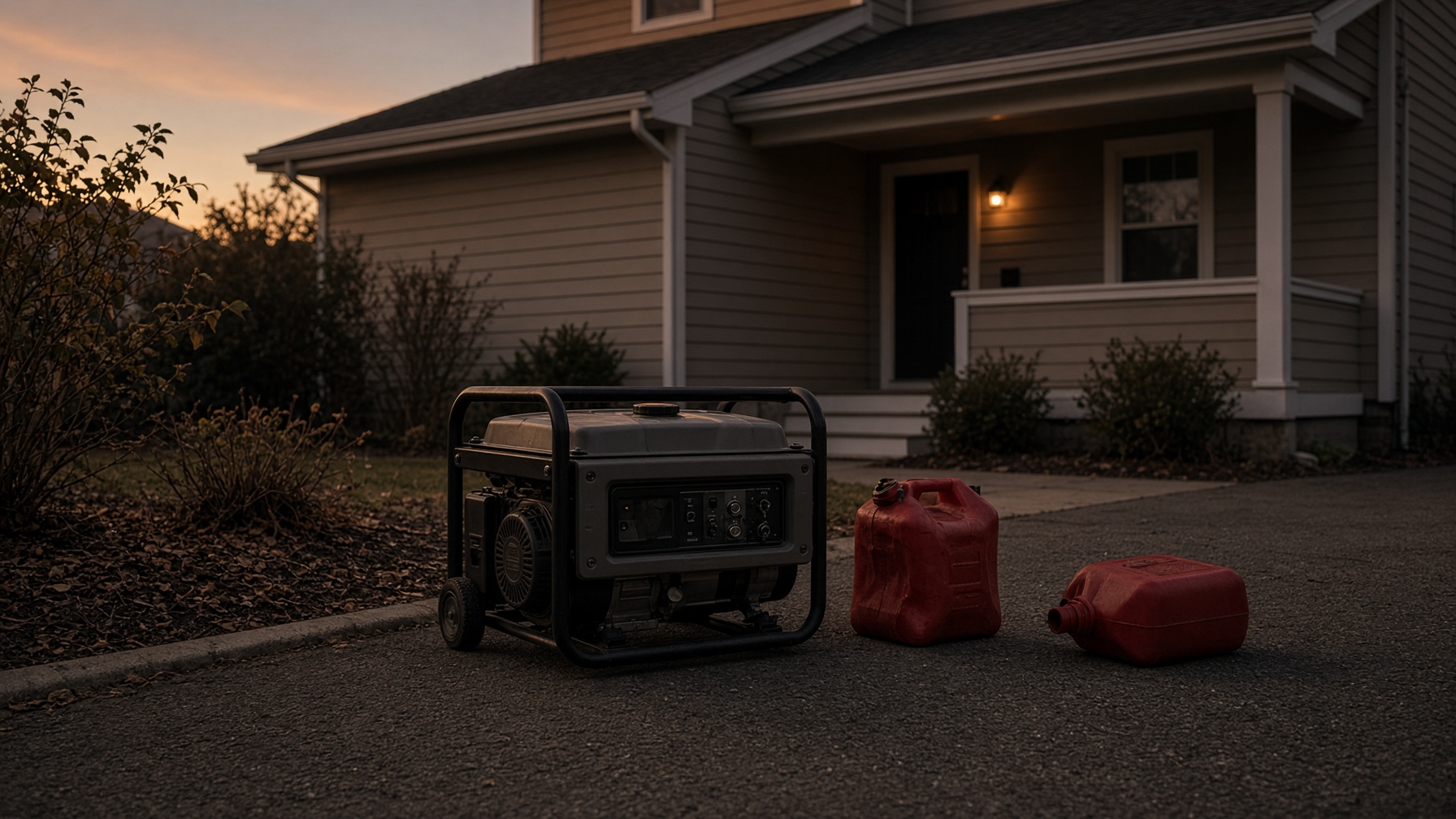
Portable generators fail socially and mechanically. They are stolen, they are run indoors and kill people with carbon monoxide, and they are run wide open until the cans are empty on the second night. None of that is a technology problem.
Carbon monoxide is the failure that does not need a second debate. A generator or a grill run in a house, a garage, or against a window puts a gas you cannot see where people are sleeping. The alarm is in the plan because cold people ignore the rule. The rule stays the rule. Outside, away from how the house breathes, or not at all.
The working pattern is a short list of loads — the freezer in bursts, a phone radio, a medical device — and a written hours-per-day cap. Store fuel stabilized, outside living space, and assume you will not be driving across town to replace it.
Write the loads in order. A medical device that must run continuously comes before a freezer that can duty-cycle if the door stays shut. A phone radio is a small load with a large use. The hours-per-day cap is what keeps night two from eating the fuel for day four. “Until the cans are empty” is not a cap.
Solar charging of small batteries is the quieter cousin. It will not run a house. It will run the radio that tells you whether you should.
Stabilized fuel stored outside living space is fuel you decided will still be fuel. Treat the stock as the whole stock. The plan that includes driving across town assumes open roads, working station pumps, and a line of people who had the same idea. If the cans are not already at the house, they are not in the outage.
A small solar charger will not carry a house, and it will not advertise itself the way a generator does. Theft is part of why generators fail socially: they are loud proof that someone still has power and fuel. Use the quiet charge for the radio, a light, and the phones you still have a reason to run. Save the engine for the loads that earn the noise and the risk.
Sources
- Power Outage Safety — American Red Cross · the article this brief was written from
- Build a Kit — Ready.gov / FEMA
- Electromagnetic Pulse and Geomagnetic Disturbance — Cybersecurity and Infrastructure Security Agency
More in Survival
- The first seventy-two hours are a sequence, not a vibe
by: Andrew, Co-Founder at Blackout Briefing
- A three-day kit is the opening bid, not the whole plan
by: Andrew, Co-Founder at Blackout Briefing
- Seven days in, the problem is information as much as calories
by: Andrew, Co-Founder at Blackout Briefing
Recent news
EMP
The civilian grid is still the soft target in a high-altitude pulseby: Andrew, Co-Founder at Blackout Briefing
CME
A Carrington-class storm is a when, not a science-fiction ifby: Andrew, Co-Founder at Blackout Briefing
Grid
Metcalf still explains the grid better than most white papersby: Andrew, Co-Founder at Blackout Briefing