CME · Saturday, October 17
The 2012 storm missed Earth by about nine days
NASA has said a Carrington-class CME that year would have hit if the planet had been a little farther along in its orbit.
by: Andrew, Co-Founder at Blackout Briefing
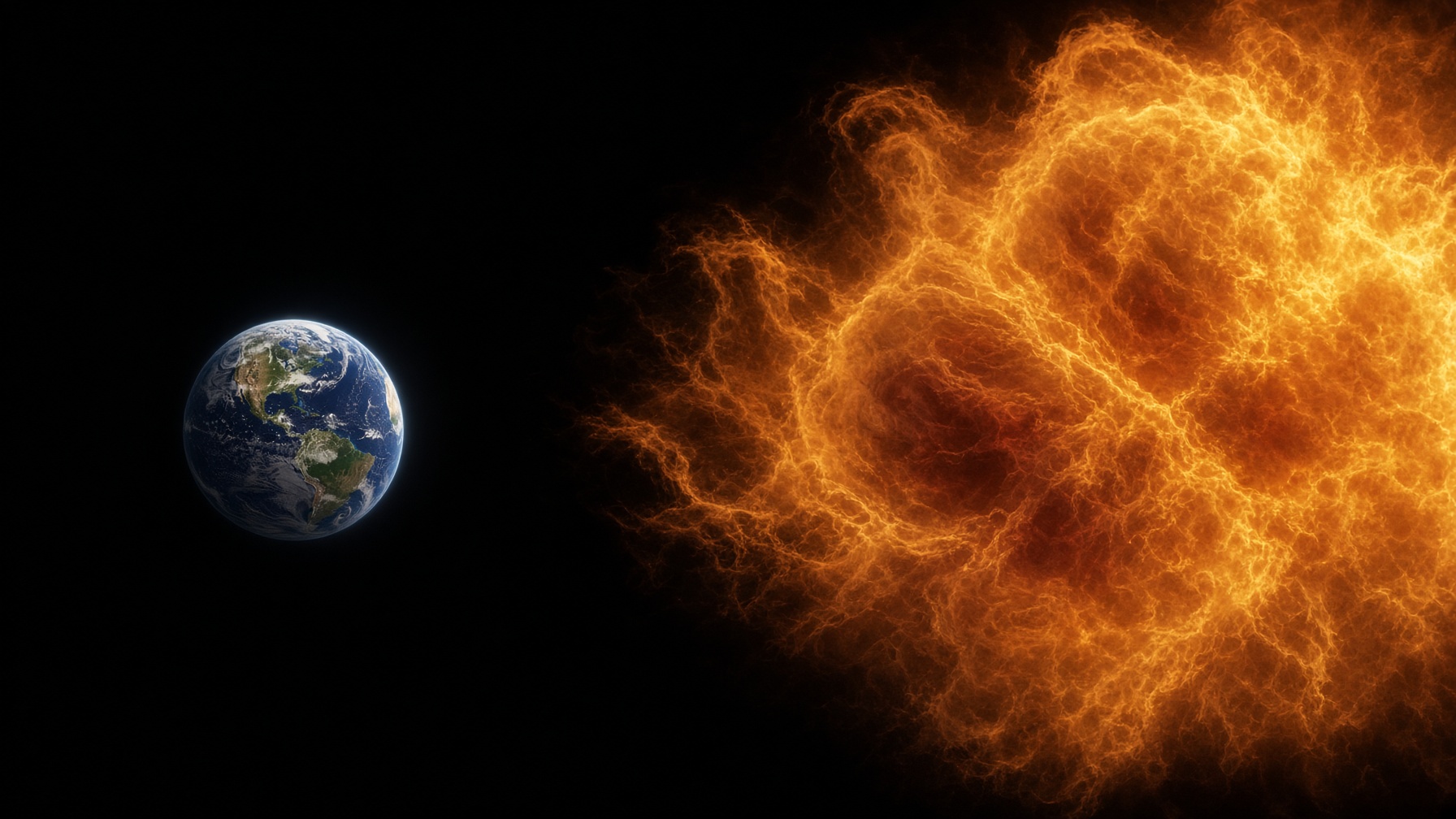
In July 2012 the sun launched a fast, huge coronal mass ejection. It crossed the orbit of Earth. The planet was not in that spot. Spacecraft that were — STEREO among them — recorded a storm that solar physicists compare to the Carrington Event.
The miss was orbital timing. The cloud crossed the path Earth travels and the planet was elsewhere on that path, by about nine days. It did not swerve out of courtesy. A Carrington-class ejection does not require a different sun. It requires the planet to be in the spot it occupies on an ordinary day of the month. Spacecraft that were in the spot recorded what we missed.
Near-misses are easy to shrug off because nothing broke. They are also the cleanest evidence that the sun’s current machinery still produces civilization-scale storms, not just nineteenth-century ones. The grid we have now is larger, more interconnected, and more electronic than the one Quebec lost in 1989.
Larger means more conductor to couple into. More interconnected means neighbors can support each other until the ties themselves are the limit. More electronic means the controls and the newer generation equipment sit inside the problem, not beside it. The grid Quebec lost was modern for that year. It was not this one. A shrug because nothing broke on the ground confuses luck with a change in the sun.
Forecasting has improved enough to give operators a window. The unfinished work is what they are allowed, staffed, and equipped to do inside that window.
Near-misses make poor exhibits. No freezer failed, so the public record is thin outside the people who read spacecraft data. The useful exhibit is the comparison those physicists made: the machinery that produced the Carrington Event is still capable of a storm they are willing to set beside it. Waiting for broken hardware before believing the instruments is a choice to learn later.
A forecast window is only operational if three things exist inside it. Allowed: a rule that permits taking vulnerable equipment offline when customers will feel it and the storm might still miss. Staffed: people at the desk who have practiced that rule. Equipped: the actual switching options, blockers, or spares, not a study that recommends them. A clearer picture of the sun, shining on an empty toolbox, is still a blackout.
Sources
- Near Miss: The Solar Superstorm of July 2012 — NASA Science · the article this brief was written from
- NOAA Space Weather Scales — NOAA Space Weather Prediction Center
- Space Weather: Policy and U.S. Government Roles (CRS R46049) — Congressional Research Service
More in CME
- A Carrington-class storm is a when, not a science-fiction if
by: Andrew, Co-Founder at Blackout Briefing
- G2 is a nuisance until it is pointed at the wrong transformer
by: Andrew, Co-Founder at Blackout Briefing
- Quebec, 1989, is still the cleanest warning the grid has
by: Andrew, Co-Founder at Blackout Briefing
Recent news
EMP
The civilian grid is still the soft target in a high-altitude pulseby: Andrew, Co-Founder at Blackout Briefing
Grid
Metcalf still explains the grid better than most white papersby: Andrew, Co-Founder at Blackout Briefing
Survival
The first seventy-two hours are a sequence, not a vibeby: Andrew, Co-Founder at Blackout Briefing