Unrest · Thursday, October 15
A dark city is not a riot waiting to happen
Most outages produce inconvenience, neighborliness, and bad traffic. Predicting chaos is how panic gets a head start.
by: Andrew, Co-Founder at Blackout Briefing
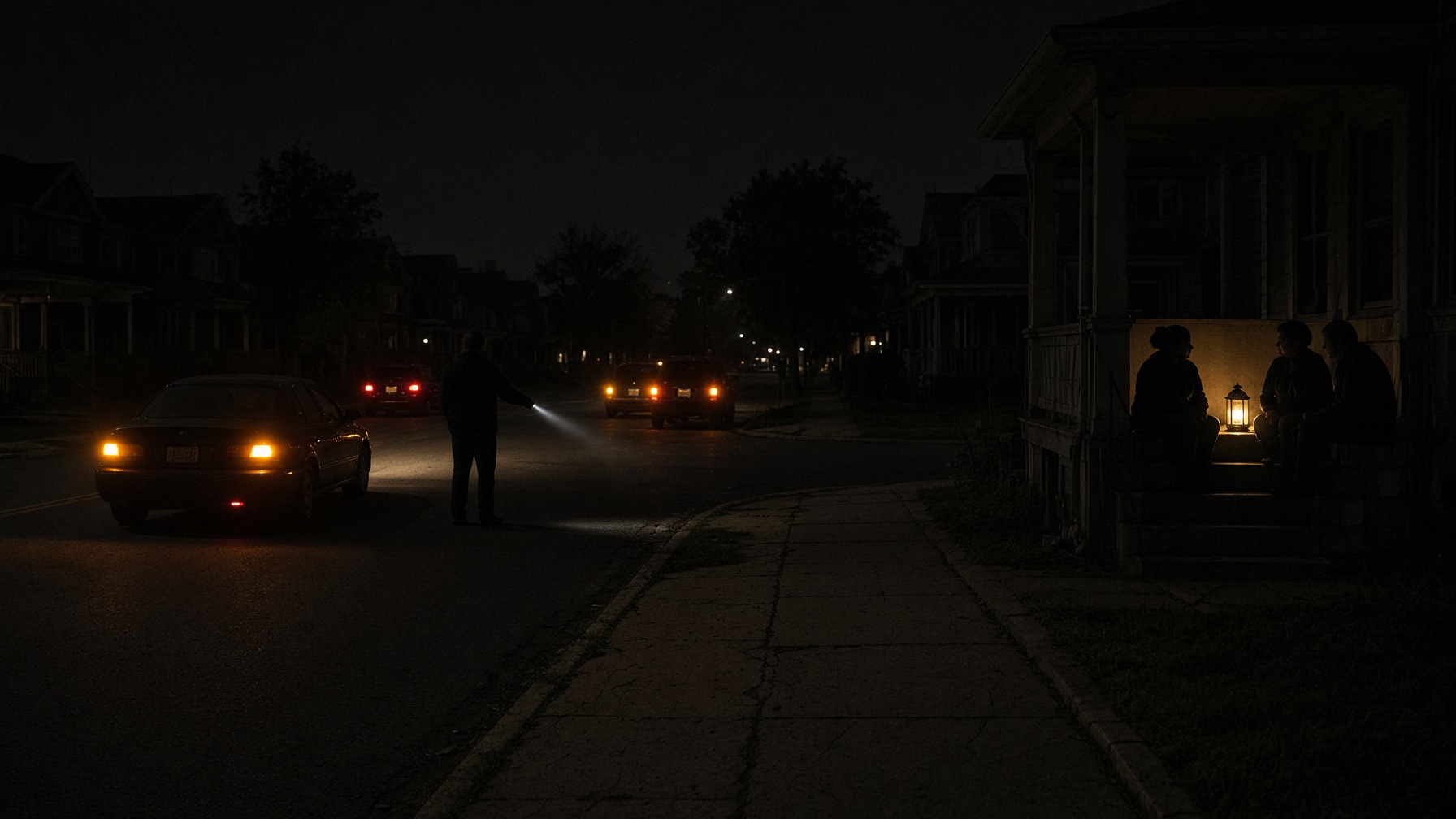
American experience of blackouts is mostly people directing traffic at dead lights, checking on stairs, and complaining. The dramatic exceptions are real and should not be turned into the expected case. Expectation changes behavior. If everyone is told to fear everyone else, the hardware failure becomes a social one.
A dead signal is an electrical appliance, and the human standing in the intersection is the usual patch. That scene is common enough to fall out of the story people later call the blackout. The exception remains. The retelling then teaches the next city to expect the exception before the intersection.
Neighborliness is the common case, and it is not a guarantee. It is more likely when the public sentence is inconvenience and ordinary help, and less likely when the sentence is that everyone else has decided you are a target. Nobody fully controls that. Officials and headlines do hand people a script. The memory of 1977 is what a bad script can cost. It is not a forecast for every later outage.
The useful posture is specific. Know your block. Keep small cash. Do not go looking for a crowd. Offer ordinary help. Leave if you have a specific danger — fire, a gas smell, a medical device — not because a stranger online declared the city lost.
Going to look for a crowd is an errand with a rumor under it: a store supposedly giving things out, a neighborhood supposedly impassable, an authority who supposedly said to flee. Ordinary help is the opposite errand. It stays on the block. It does not require travel toward the noise.
The reasons to leave are physical. Fire, the smell of gas, a medical device that will not run. Boredom is not one of them. Neither is a post declaring that cities always break. A family that leaves for the specific danger is using the plan. A family that leaves because a stranger declared the city lost has joined the traffic the dead lights already worsened.
Ready.gov’s list is social in disguise. A radio, a light, and water are how a family stays out of the street. The light is for the stair. The water is so you are not standing in a line for nothing. The radio is so the stranger's declaration has to compete with a sentence that has an office behind it.
Sources
- Con Edison power failure of July 13 and 14, 1977. Final staff report — U.S. Department of Energy / OSTI · the article this brief was written from
- Evaluation of the Physical Security Reliability Standard and Physical Attacks on the Bulk-Power System — Federal Energy Regulatory Commission
- Electromagnetic Pulse and Geomagnetic Disturbance — Cybersecurity and Infrastructure Security Agency
More in Unrest
- Attacks on substations are now a pattern in the public record
by: Andrew, Co-Founder at Blackout Briefing
- The 1977 New York blackout was a social failure on top of an electrical one
by: Andrew, Co-Founder at Blackout Briefing
- Rumor is the accelerant once the phones thin out
by: Andrew, Co-Founder at Blackout Briefing
Recent news
EMP
The civilian grid is still the soft target in a high-altitude pulseby: Andrew, Co-Founder at Blackout Briefing
CME
A Carrington-class storm is a when, not a science-fiction ifby: Andrew, Co-Founder at Blackout Briefing
Grid
Metcalf still explains the grid better than most white papersby: Andrew, Co-Founder at Blackout Briefing