Unrest · Saturday, October 17
Rumor is the accelerant once the phones thin out
In a wide outage, the first scarce good after water is a shared account of what happened.
by: Andrew, Co-Founder at Blackout Briefing
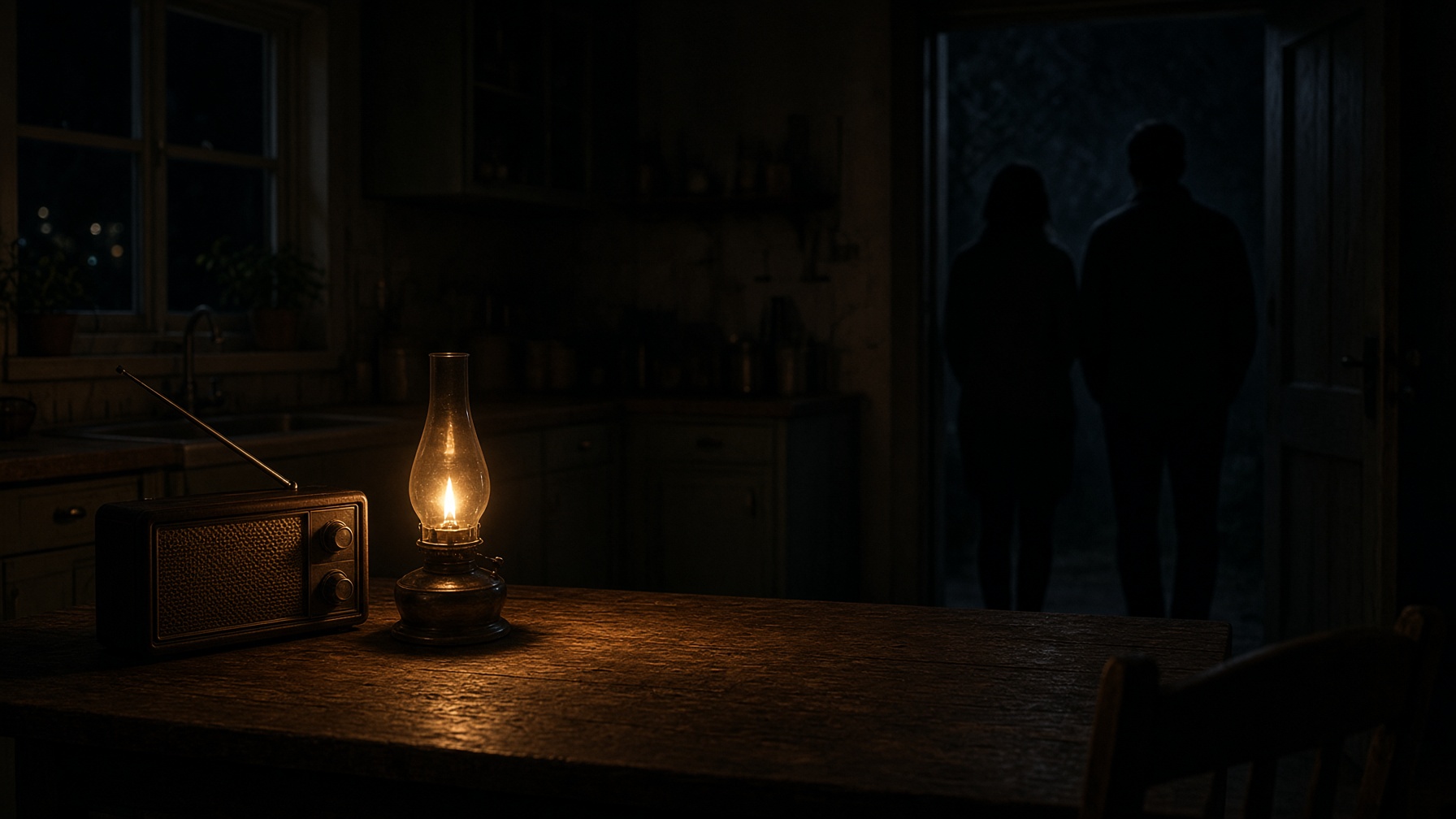
Ready.gov’s kit list still includes a battery or hand-crank radio because official information is a supply. When that supply fails, group chats and strangers fill it. Some of the fill is comfort. Some of it is a reason to run toward a store or away from a neighborhood.
Phones thin out for ordinary reasons: batteries, crowded cells, sites that lose power. What is left can feel complete because it is the only conversation in the room. Comfort is not the hazard. The message that tells people to move is the hazard. Movement is where a hardware failure collects a crowd.
Unrest is often downstream of a false picture: the idea that no one is coming, or that everyone else is already taking things, or that a particular group caused the dark. A single calm, repeated fact — what failed, what to do, when the next update is — is an operational tool.
The time of the next update is the part that makes the fact hold. A sentence with no successor gets replaced by whoever speaks later. "We do not know yet" is a legitimate report if it comes with the time you will know more. It is not legitimate as a reason to leave the official supply unread.
The version that names a particular group as the cause is how a blackout becomes a hunt. Nothing about a tripped line identifies a neighbor. Repeating that claim is not passing news. It is feeding the accelerant. The rule is the same as for every other unsourced note: if it has no source, it does not get repeated in the house.
If you run a household, assign one person to the radio and agree not to treat unsourced voice notes as news. This paper will try to be the kind of account you can check against a document.
One person means one notebook, not a contest among everyone harvesting a different chat. The assigned person writes what the official supply said, reads it back, and does not upgrade it into a plan to drive. If this paper cannot be set beside a document on the same point, it should lose to silence, not win against the voice note.
Sources
- Con Edison power failure of July 13 and 14, 1977. Final staff report — U.S. Department of Energy / OSTI · the article this brief was written from
- Evaluation of the Physical Security Reliability Standard and Physical Attacks on the Bulk-Power System — Federal Energy Regulatory Commission
- Electromagnetic Pulse and Geomagnetic Disturbance — Cybersecurity and Infrastructure Security Agency
More in Unrest
- Attacks on substations are now a pattern in the public record
by: Andrew, Co-Founder at Blackout Briefing
- The 1977 New York blackout was a social failure on top of an electrical one
by: Andrew, Co-Founder at Blackout Briefing
- The physical-security standard covers the yards that can cascade, not every fence
by: Andrew, Co-Founder at Blackout Briefing
Recent news
EMP
The civilian grid is still the soft target in a high-altitude pulseby: Andrew, Co-Founder at Blackout Briefing
CME
A Carrington-class storm is a when, not a science-fiction ifby: Andrew, Co-Founder at Blackout Briefing
Grid
Metcalf still explains the grid better than most white papersby: Andrew, Co-Founder at Blackout Briefing