Unrest · Sunday, October 18
The 1977 New York blackout was a social failure on top of an electrical one
Lightning and protective relays started it. Looting and a collapse of confidence finished the memory.
by: Andrew, Co-Founder at Blackout Briefing
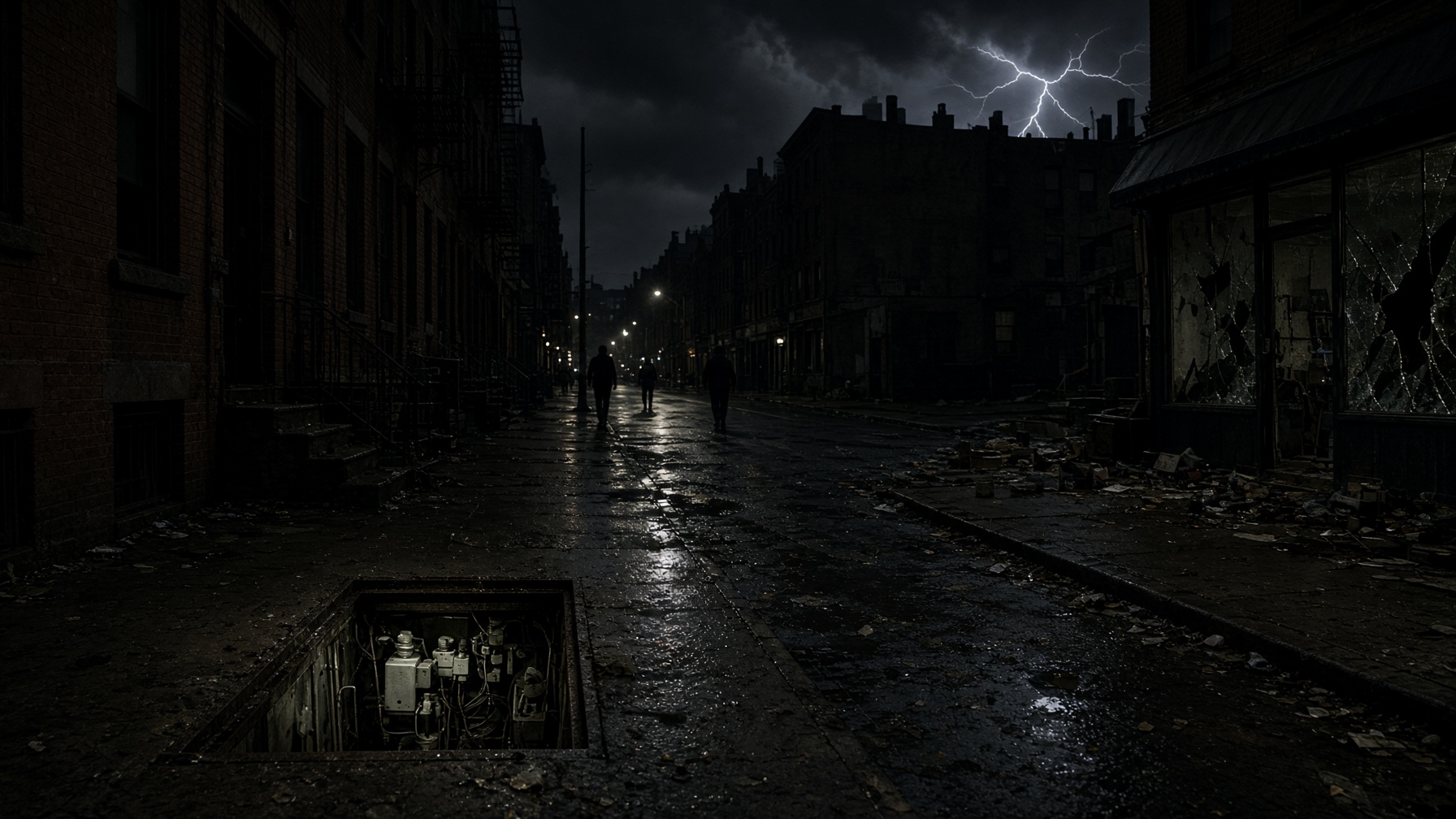
On the hot night of 13 July 1977, New York City went dark after a storm-driven set of trips. What people still cite is not the relay settings. It is the disorder that followed in parts of the city, and the years of argument about poverty, policing, and whether a blackout reveals a place or breaks it.
The electrical sequence is real, and it is not the memory. Weather and protective relays took the system down. What lasted in public argument is what some people did after that, and what conditions they were already living in. A story that starts at the disorder and never mentions the storm has dropped the cause. A story that ends at the relays has dropped why the night is still cited.
Later North American blackouts did not repeat that scene at the same scale. The lesson is not that darkness equals riot. It is that a blackout lands on whatever trust and strain already exist, and that officials who sound surprised by human beings are late.
Surprise means the plan never included the public as they are. A press conference that assumes calm because the speakers feel calm has not looked at the block. A briefing that predicts chaos as the natural law of darkness helps that result along. The argument after 1977 is still useful because it refuses both automatic stories.
Scale belongs in the sentence. Disorder in parts of a city is not a description of every street that night, and a later outage that stays mostly quiet does not erase the earlier one. The history is conditional: where strain is already high, darkness is a worse shock. Where people have light, a shared fact, and each other, the same loss of power can remain an electrical event.
A preparedness plan that is only cans, with no thought for how the block behaves, is half a plan. The other half is boring: lights, information, and people who already know each other.
A light keeps a stair from turning into a rumor. Information keeps the loudest person on the sidewalk from being the only narrator. People who already know each other can check a door without being assigned it. None of that rewrites a hot night in 1977. It is the half of the plan a household can still add.
Sources
- Con Edison power failure of July 13 and 14, 1977. Final staff report — U.S. Department of Energy / OSTI · the article this brief was written from
- Evaluation of the Physical Security Reliability Standard and Physical Attacks on the Bulk-Power System — Federal Energy Regulatory Commission
- Electromagnetic Pulse and Geomagnetic Disturbance — Cybersecurity and Infrastructure Security Agency
More in Unrest
- Attacks on substations are now a pattern in the public record
by: Andrew, Co-Founder at Blackout Briefing
- Rumor is the accelerant once the phones thin out
by: Andrew, Co-Founder at Blackout Briefing
- The physical-security standard covers the yards that can cascade, not every fence
by: Andrew, Co-Founder at Blackout Briefing
Recent news
EMP
The civilian grid is still the soft target in a high-altitude pulseby: Andrew, Co-Founder at Blackout Briefing
CME
A Carrington-class storm is a when, not a science-fiction ifby: Andrew, Co-Founder at Blackout Briefing
Grid
Metcalf still explains the grid better than most white papersby: Andrew, Co-Founder at Blackout Briefing