Unrest · Sunday, October 11
A false cause spreads faster than a repair crew
Outages attract villains. The repair still takes the time the equipment takes.
by: Andrew, Co-Founder at Blackout Briefing
Every large blackout produces a culprit of the hour: a foreign government, a political faction, a utility conspiracy, a neighbor. Sometimes an investigation later finds a human attacker or a failed piece of equipment. Often it finds weather, a tree, or a protection system that did what it was set to do.
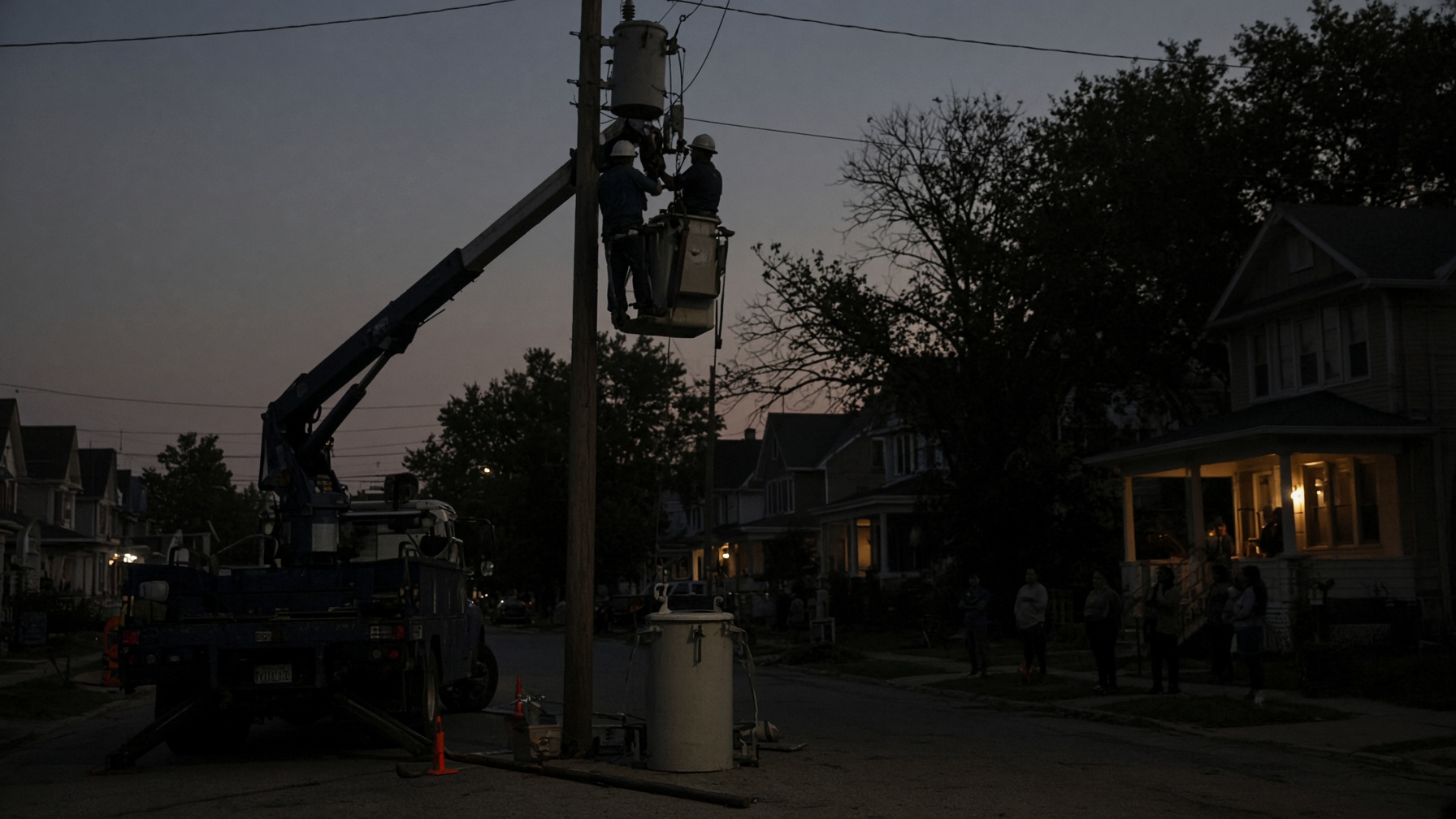
The culprit arrives first because a name feels like an explanation. The repair arrives on the equipment’s clock: a crew that can reach the site, a part that fits, a line that can be worked safely. Those are not the same speed. The early false version is cheap to send and expensive to take back, because people have already repeated it as if it were the update.
A protection system that did what it was set to do is the least satisfying true ending. The lights went out because a device opened a circuit rather than let a worse failure spread. That is not a villain. It is a setting, a piece of equipment, and a consequence, and it will lose a race against any story that offers an enemy in the first hour.
The cost of the early false version is not only embarrassment. It is a crowd at the wrong gate, a threat against the wrong people, and a public that will not believe the boring corrective.
The wrong gate is a place, not a figure of speech. The wrong people are often the workers trying to put the power back. A rumor can find both before a document does. Embarrassment is the small cost. The larger one is a public that has already picked a story and will hear the later, duller fact as an excuse.
Blackout Briefing’s rule on this desk: name a cause when a document names it. Until then, describe the effect and the next official update.
What a reader can do with the gap is narrow on purpose. Repeat who is dark and what the next official update is. Do not promote the culprit of the hour just to fill the quiet. The quiet is unpleasant. A crowd at the wrong fence is worse, and it does not put the part on the truck.
Sources
- Con Edison power failure of July 13 and 14, 1977. Final staff report — U.S. Department of Energy / OSTI · the article this brief was written from
- Evaluation of the Physical Security Reliability Standard and Physical Attacks on the Bulk-Power System — Federal Energy Regulatory Commission
- Electromagnetic Pulse and Geomagnetic Disturbance — Cybersecurity and Infrastructure Security Agency
More in Unrest
- Attacks on substations are now a pattern in the public record
by: Andrew, Co-Founder at Blackout Briefing
- The 1977 New York blackout was a social failure on top of an electrical one
by: Andrew, Co-Founder at Blackout Briefing
- Rumor is the accelerant once the phones thin out
by: Andrew, Co-Founder at Blackout Briefing
Recent news
EMP
The civilian grid is still the soft target in a high-altitude pulseby: Andrew, Co-Founder at Blackout Briefing
CME
A Carrington-class storm is a when, not a science-fiction ifby: Andrew, Co-Founder at Blackout Briefing
Grid
Metcalf still explains the grid better than most white papersby: Andrew, Co-Founder at Blackout Briefing