CME · Wednesday, October 14
Forecasts are finally good enough to be operational
Satellites see eruptions leave the sun. The remaining gamble is the magnetic field that decides how hard they hit.
by: Andrew, Co-Founder at Blackout Briefing
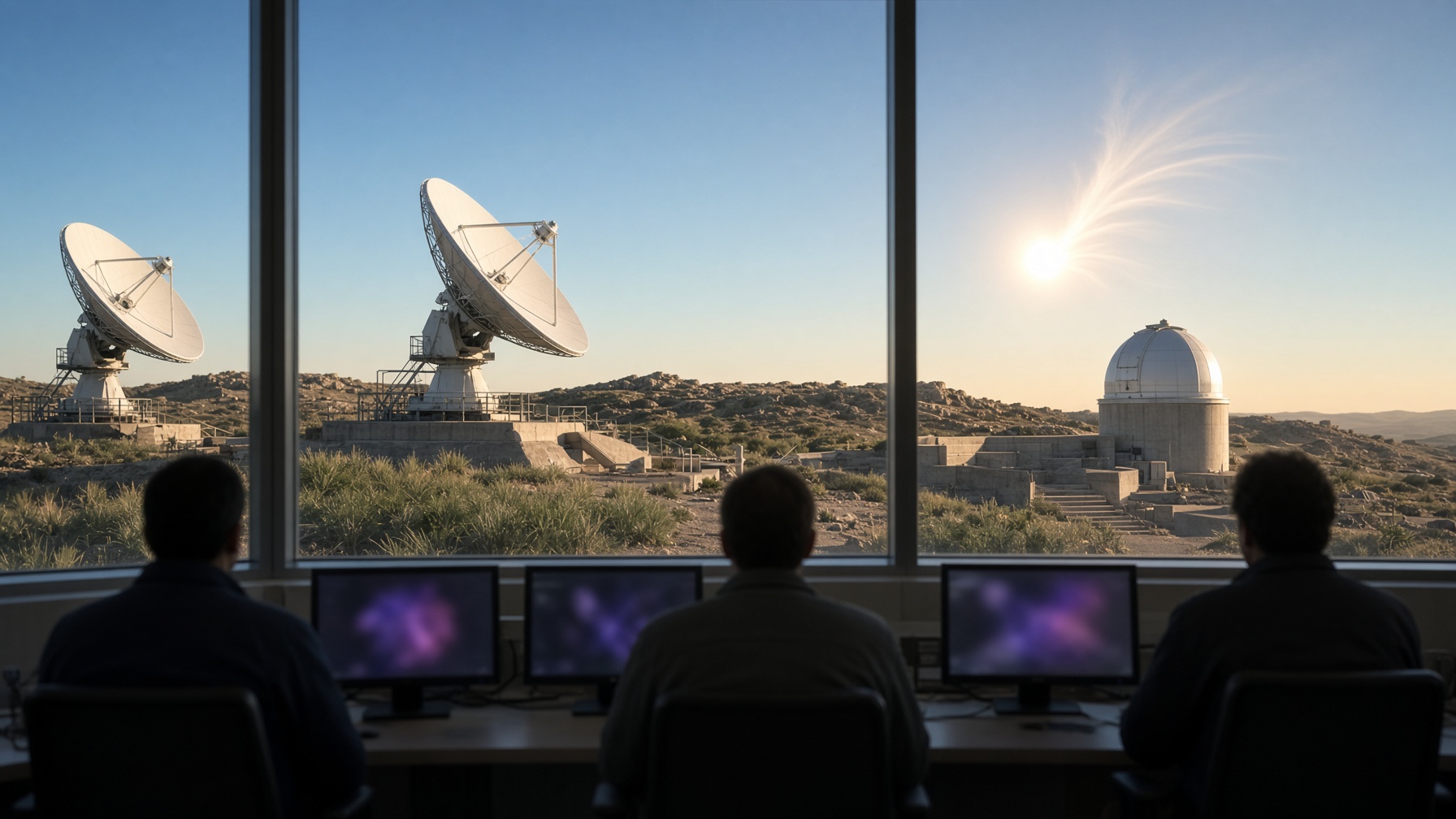
A coronagraph can watch a CME lift off and models can estimate arrival within a window of hours. That is a different world from 1859, when the first sensor was a magnetometer and a sky full of aurora. Grid control rooms can, in principle, change the system before the shock.
A coronagraph can see a coronal mass ejection lift off. Models turn that departure into an arrival window measured in hours. That is a different world from a magnetometer and a sky that has already changed. “In principle” is the part to keep. Control rooms can change the system before the shock only if the window is paired with decisions that were written when nobody was in a hurry.
The stubborn unknown is Bz, the north-south component of the cloud’s magnetic field, which is hard to know until the cloud is almost here. A well-aimed storm and a glancing blow can leave the sun looking similar and the ground looking completely different.
Bz, the north-south component of the cloud’s field, is the stubborn unknown because it is hard to measure until the cloud is almost here. Two eruptions can look alike at the sun. One can be well aimed and drive damaging current. One can be a glancing blow and leave a different ground entirely. The similar image is why both false confidence and false calm are available from the same early picture.
The operational habit that matches the science: pre-write the actions for a severe watch, so the last hour is execution, not a meeting.
The last-hour instruments close some of that gap by sampling the cloud itself. They do not create extra days. Some actions under a severe watch are cheap and reversible. Some take equipment offline and will draw complaints if the storm then fizzles. If the cheap steps wait for the same certainty as the expensive ones, both kinds of step happen late. Uncertainty is a reason to rank the actions, not a reason to hold all of them.
Pre-writing is a checklist with names. Who may treat a severe watch as actionable. Which equipment is unloaded first. Who tells the public, on one channel, what was done. The last hour will still contain the magnetic field arriving as news. It should not contain the first argument about whether anyone is allowed to touch the system. Execution is the operational habit that matches a forecast this good.
Sources
- Alerts, Watches and Warnings — NOAA Space Weather Prediction Center · the article this brief was written from
- NOAA Space Weather Scales — NOAA Space Weather Prediction Center
- Space Weather: Policy and U.S. Government Roles (CRS R46049) — Congressional Research Service
More in CME
- A Carrington-class storm is a when, not a science-fiction if
by: Andrew, Co-Founder at Blackout Briefing
- G2 is a nuisance until it is pointed at the wrong transformer
by: Andrew, Co-Founder at Blackout Briefing
- Quebec, 1989, is still the cleanest warning the grid has
by: Andrew, Co-Founder at Blackout Briefing
Recent news
EMP
The civilian grid is still the soft target in a high-altitude pulseby: Andrew, Co-Founder at Blackout Briefing
Grid
Metcalf still explains the grid better than most white papersby: Andrew, Co-Founder at Blackout Briefing
Survival
The first seventy-two hours are a sequence, not a vibeby: Andrew, Co-Founder at Blackout Briefing