Unrest · Wednesday, October 14
Mutual aid is the old technology that still scales
The utilities roll trucks across state lines after storms. Blocks can do a smaller version without a press conference.
by: Andrew, Co-Founder at Blackout Briefing
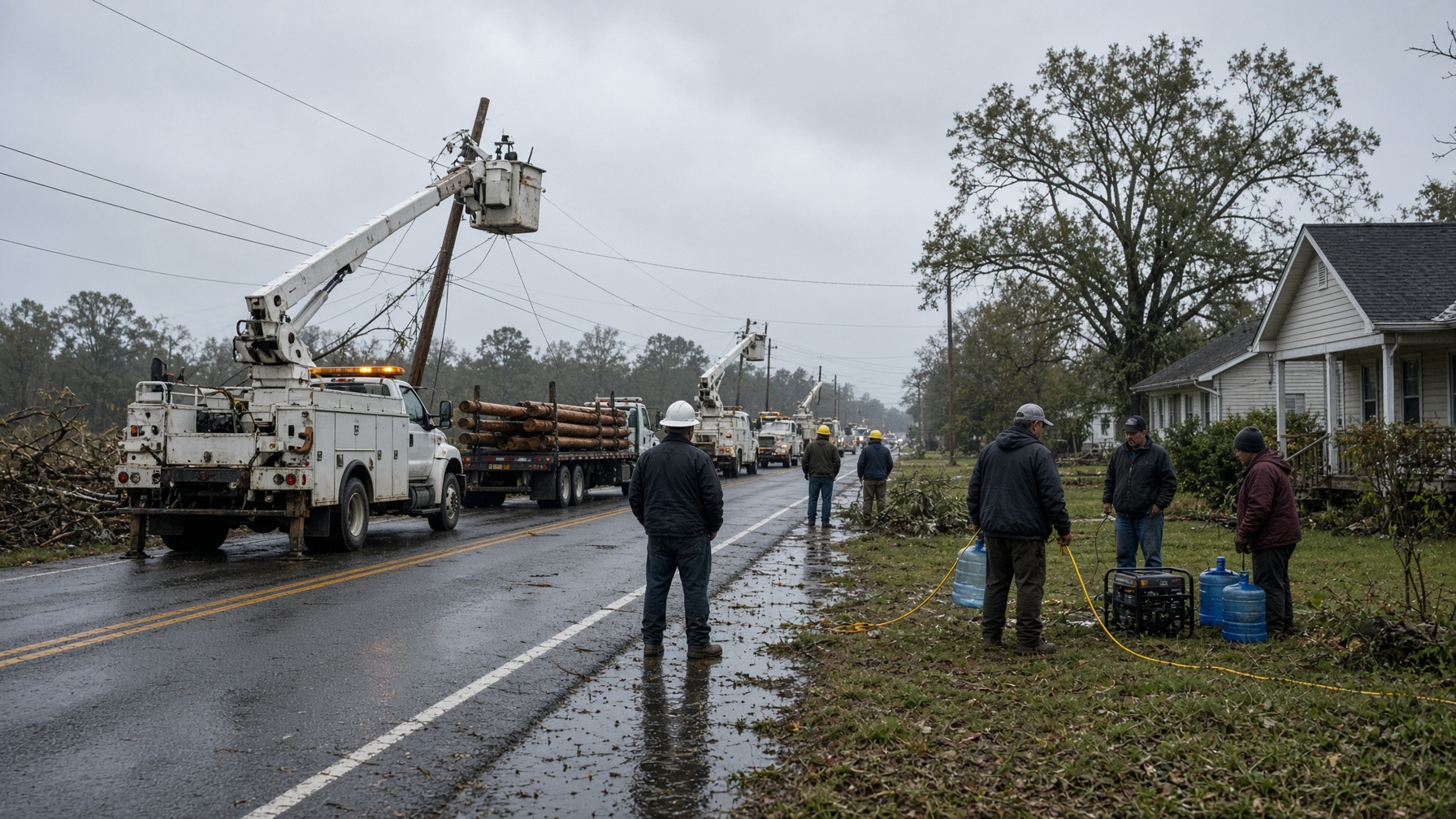
Investor-owned utilities and cooperatives have spent decades proving that crews will travel to someone else’s disaster. That culture fails when the damage is everywhere at once, which is the EMP and great-storm case. It works remarkably well when the damage is regional.
The mechanism is agreements and a habit of picking up the phone, plus a yard that can spare a truck because its own weather is still ordinary. A regional storm is the case this was built for. The visiting crew brings practiced hands. The host still has to know its own system. The truck is a multiplier, not a substitute for a local plan.
Everywhere at once is the case where the utility you would call is in the same dark, with its own damaged equipment and its own towns. Mutual aid cannot borrow a crew from a region that is not there. That limit is the electromagnetic and great-storm case. It is a reason to describe the agreements accurately, not a reason to throw them out. They are not a national generator.
Underneath it, the unrest-resistant pattern is the same: people who already have a job. Who has water. Who checks the stairwell. Who watches the kids of the person standing in a generator line. None of that requires a vest.
The generator line is the example that makes the jobs concrete. The adult standing in it cannot also be the adult on the stair. If nobody was named, the line creates a second outage inside the building. Block-scale mutual aid is the earlier decision that the stair and the children belong to someone who is not in that line.
The work does not need a title because it is not an authority. It is recognition. The neighbor with water does not need a vest to share it. The neighbor who was never introduced will be slower to knock, and may not know which door needs it. Utilities keep that fact as a contact list. A building's version is shorter, and blank if it was never made.
Introduce yourself before the outage. Afterward is a worse time to learn your neighbor’s name. A name learned in the dark still counts. A name learned while nothing was wrong is a small crew the building already has.
Sources
- Build a Kit — Ready.gov / FEMA · the article this brief was written from
- Evaluation of the Physical Security Reliability Standard and Physical Attacks on the Bulk-Power System — Federal Energy Regulatory Commission
- Electromagnetic Pulse and Geomagnetic Disturbance — Cybersecurity and Infrastructure Security Agency
More in Unrest
- Attacks on substations are now a pattern in the public record
by: Andrew, Co-Founder at Blackout Briefing
- The 1977 New York blackout was a social failure on top of an electrical one
by: Andrew, Co-Founder at Blackout Briefing
- Rumor is the accelerant once the phones thin out
by: Andrew, Co-Founder at Blackout Briefing
Recent news
EMP
The civilian grid is still the soft target in a high-altitude pulseby: Andrew, Co-Founder at Blackout Briefing
CME
A Carrington-class storm is a when, not a science-fiction ifby: Andrew, Co-Founder at Blackout Briefing
Grid
Metcalf still explains the grid better than most white papersby: Andrew, Co-Founder at Blackout Briefing