Unrest · Monday, October 12
Order in a blackout is mostly local and mostly unglamorous
Traffic, welfare checks, and a visible person with a radio do more than a rumor about troops.
by: Andrew, Co-Founder at Blackout Briefing
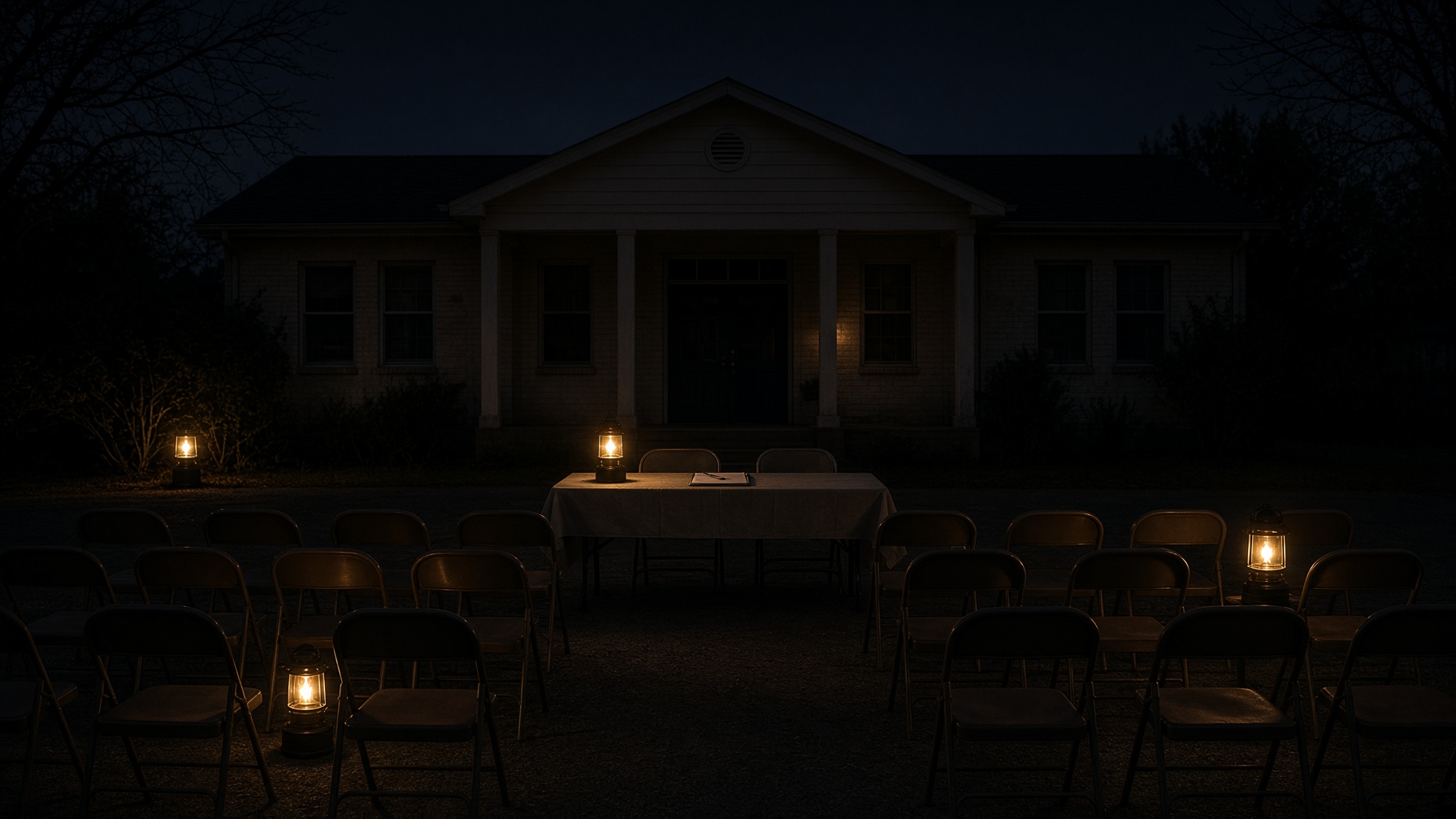
The first responders in a city outage are often the people already on shift: police and fire who cannot rely on signals, utility staff, hospital charge nurses, and whoever starts directing cars at an intersection. National Guard activations happen. They are not the first hour.
The signals those people use fail with the rest. A radio that was not charged, a tower on a dying battery, a dispatch screen that has gone blank: the person at the corner is working with a car, a voice, and whatever drivers will follow. That is the first hour. It does not look like a plan announced from somewhere else. It is the capacity actually on the street.
A National Guard activation is a public fact when it happens. It also takes a request, and it takes time to move. People who spend the first night waiting for troops are waiting past the hour when intersections, checks on the sick, and the edge of the hospital are already being handled by whoever was on shift.
Officials help when they are specific and present. A curfew announced with no way for people to hear it is not a curfew. A warming or charging site with a stated hour is an institution.
A warming or charging site works because it is a place, a clock, and a person. A rumor about troops is a story. It does not heat a room, and it does not charge the radio the next instruction would have to travel on. Officials who announce a rule they have no way to transmit have announced a wish.
If you are able-bodied and not needed at home, the useful volunteer job is usually water, welfare checks, or traffic — offered to the people already doing it, not freelanced as security.
The limit is the point of the advice. Water, a knock on a door, a hand at a corner where someone is already waving cars through. People caring for someone who cannot be left alone are already at their job. Showing up with a weapon and a private theory of order is not the unpaid version of the shift. It is a second problem for the people who were already there.
Sources
- Con Edison power failure of July 13 and 14, 1977. Final staff report — U.S. Department of Energy / OSTI · the article this brief was written from
- Evaluation of the Physical Security Reliability Standard and Physical Attacks on the Bulk-Power System — Federal Energy Regulatory Commission
- Electromagnetic Pulse and Geomagnetic Disturbance — Cybersecurity and Infrastructure Security Agency
More in Unrest
- Attacks on substations are now a pattern in the public record
by: Andrew, Co-Founder at Blackout Briefing
- The 1977 New York blackout was a social failure on top of an electrical one
by: Andrew, Co-Founder at Blackout Briefing
- Rumor is the accelerant once the phones thin out
by: Andrew, Co-Founder at Blackout Briefing
Recent news
EMP
The civilian grid is still the soft target in a high-altitude pulseby: Andrew, Co-Founder at Blackout Briefing
CME
A Carrington-class storm is a when, not a science-fiction ifby: Andrew, Co-Founder at Blackout Briefing
Grid
Metcalf still explains the grid better than most white papersby: Andrew, Co-Founder at Blackout Briefing