
Unrest · Tuesday, October 13
Protest is not the same thing as an attack on infrastructure
A public that cannot tell a march from sabotage will bless the wrong response to both.
by: Andrew, Co-Founder at Blackout Briefing
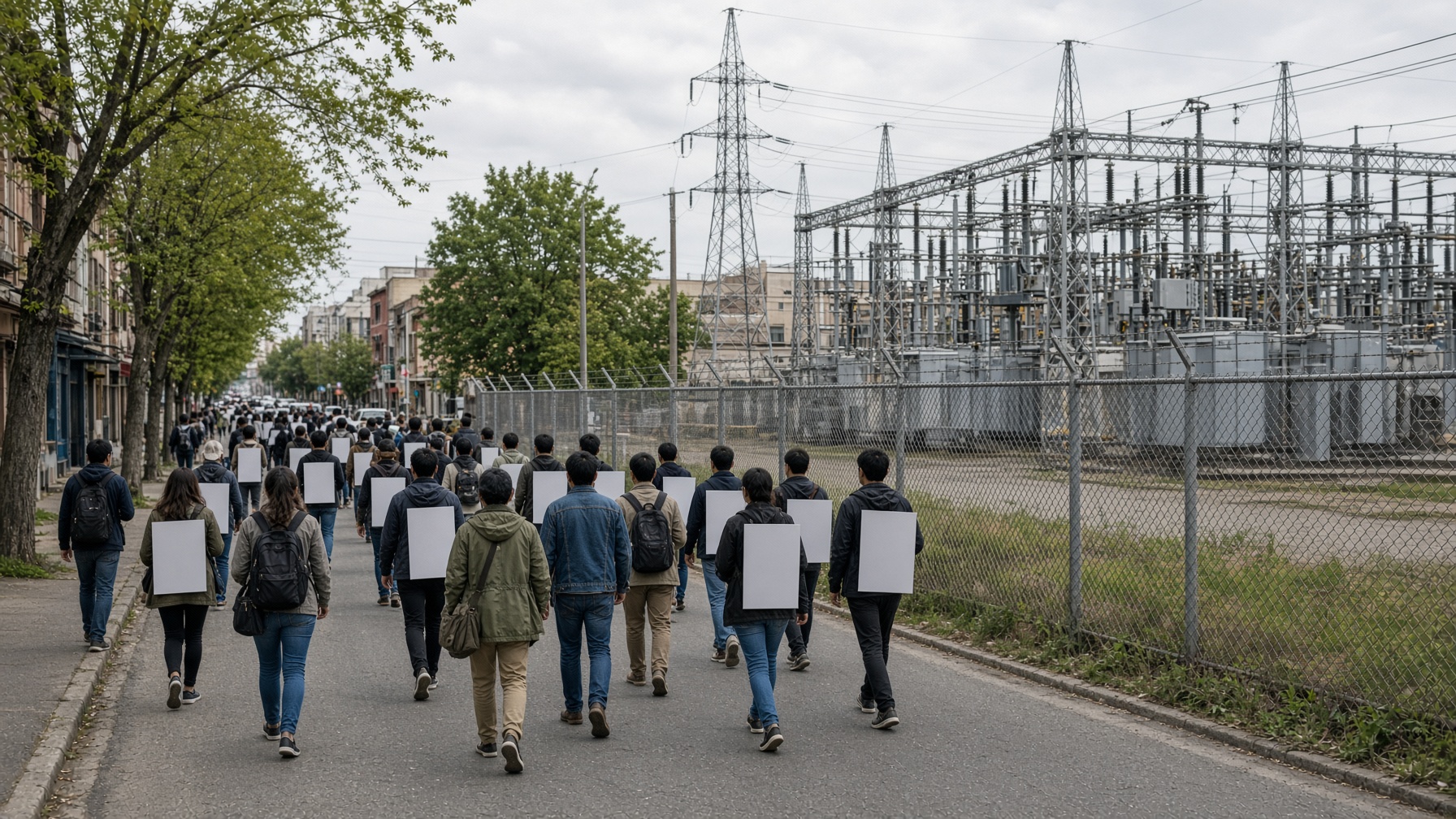
Demonstrations, labor actions, and even tense standoffs at utility gates are political events. Gunfire into transformers, cut fibers at a critical yard, and intrusions into control networks are attacks on a machine other people need to live. The public record of the last decade includes both, and they are not synonyms.
The public record is not ambiguous just because the pictures can look alike. People have stood outside utility gates with signs, and people have damaged transformers and cut fibers at yards. One of those is assembly, including assembly that is angry and in the way. The other is an attack on a machine other people need. A sentence that uses one word for both has already chosen a response.
A labor action can slow a utility. It does not, by being a labor action, destroy equipment. Readers who cannot keep those apart will ask for one official answer to two problems. Officials who take the invitation will police a march as if it were sabotage, or file sabotage under politics and leave the machine unprotected.
The mistake runs the other direction too. If every cut fence is described as protest, the physical-security problem disappears into an argument about speech. The fence still has a hole. The customers on the far side of it still need the equipment that was behind it.
FERC’s physical-security docket is about the second category. It is not a brief against assembly. Conflating them is how a blackout becomes a pretext.
This desk will report the act, the machine, and whether people lost power. A placard is the story only when the placard is the whole event. Violence against equipment does not become ordinary dissent because someone announces a motive. Ordinary dissent does not become a grid emergency because someone is frightened by it.
This desk will describe violence against equipment as what it is, and will not dress ordinary dissent as a grid emergency.
Sources
- Evaluation of the Physical Security Reliability Standard and Physical Attacks on the Bulk-Power System — Federal Energy Regulatory Commission · the article this brief was written from
- Electromagnetic Pulse and Geomagnetic Disturbance — Cybersecurity and Infrastructure Security Agency
More in Unrest
- Attacks on substations are now a pattern in the public record
by: Andrew, Co-Founder at Blackout Briefing
- The 1977 New York blackout was a social failure on top of an electrical one
by: Andrew, Co-Founder at Blackout Briefing
- Rumor is the accelerant once the phones thin out
by: Andrew, Co-Founder at Blackout Briefing
Recent news
EMP
The civilian grid is still the soft target in a high-altitude pulseby: Andrew, Co-Founder at Blackout Briefing
CME
A Carrington-class storm is a when, not a science-fiction ifby: Andrew, Co-Founder at Blackout Briefing
Grid
Metcalf still explains the grid better than most white papersby: Andrew, Co-Founder at Blackout Briefing