CME · Thursday, October 15
Radio blackouts and grid storms are cousins, not twins
An X-ray flare can silence high-frequency radio on the day side while the CME, if any, is still in transit.
by: Andrew, Co-Founder at Blackout Briefing
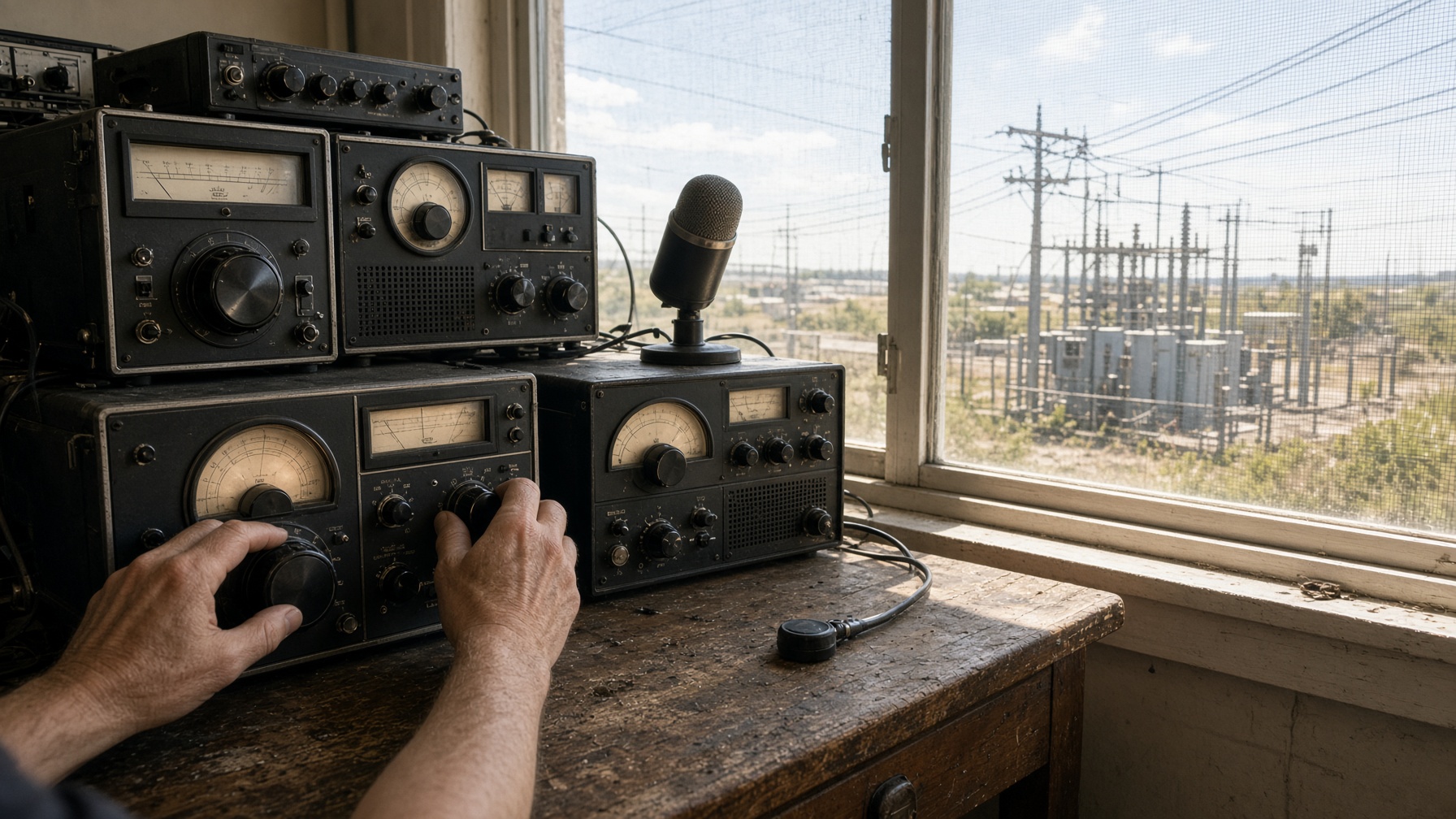
Solar flares and coronal mass ejections get mashed together in headlines. A flare’s X-rays arrive in minutes and can cause a radio blackout (the R scale) on the sunlit side of Earth. A CME is a cloud of plasma. It takes a day or three, and it is what drives geomagnetic storms.
X-rays from a flare arrive in minutes. The plasma cloud, if there is one, takes a day or three. Headlines that use one word for both will announce a grid storm on the morning the radios fade. That is often the wrong morning. The radio blackout is an R-scale event on the sunlit side. The grid storm, if it happens, is the cloud arriving later and driving geomagnetic current.
You can have a sharp radio hit and no grid impact, or a grid-relevant storm from a CME that launched with a flare nobody noticed. Operators and HF users care about both. Everyone else mostly needs to know they are not the same siren.
Sunlit side means the hemisphere facing the sun, not the whole planet going silent together. Operators on the night side can have a different high-frequency day during the same flare. A geomagnetic storm is not that neat. You can take a sharp radio hit and never see a grid impact. You can also take a grid-relevant cloud from a launch whose flare nobody put in the headline.
If your backup communication is a long-range radio, a flare day is when you learn whether your plan had a second channel.
High-frequency users care because their path disappears when the R scale spikes. Grid desks care about the geomagnetic scale and about what their own transformers are doing. Those are different sirens. A public that only has the word “solar” will hear one instruction. Operators do not. The practical distinction for everyone else is simply that the two alerts are not interchangeable.
If the backup plan is a long-range radio, a flare day is the audit. Long-range may be the channel that just failed. A second channel is local: a broadcast you can hear, a person in the same town, the meetup already written down. You do not have to work the scales to have tried that second channel once, on a day when it was not the plan’s last remaining idea.
Sources
- NOAA Space Weather Scales — NOAA Space Weather Prediction Center · the article this brief was written from
- Space Weather: Policy and U.S. Government Roles (CRS R46049) — Congressional Research Service
More in CME
- A Carrington-class storm is a when, not a science-fiction if
by: Andrew, Co-Founder at Blackout Briefing
- G2 is a nuisance until it is pointed at the wrong transformer
by: Andrew, Co-Founder at Blackout Briefing
- Quebec, 1989, is still the cleanest warning the grid has
by: Andrew, Co-Founder at Blackout Briefing
Recent news
EMP
The civilian grid is still the soft target in a high-altitude pulseby: Andrew, Co-Founder at Blackout Briefing
Grid
Metcalf still explains the grid better than most white papersby: Andrew, Co-Founder at Blackout Briefing
Survival
The first seventy-two hours are a sequence, not a vibeby: Andrew, Co-Founder at Blackout Briefing