CME · Sunday, October 11
Satellite drag is how a solar storm taxes the sky
When the upper atmosphere swells, orbits decay. The grid is not the only machine in the circuit.
by: Andrew, Co-Founder at Blackout Briefing
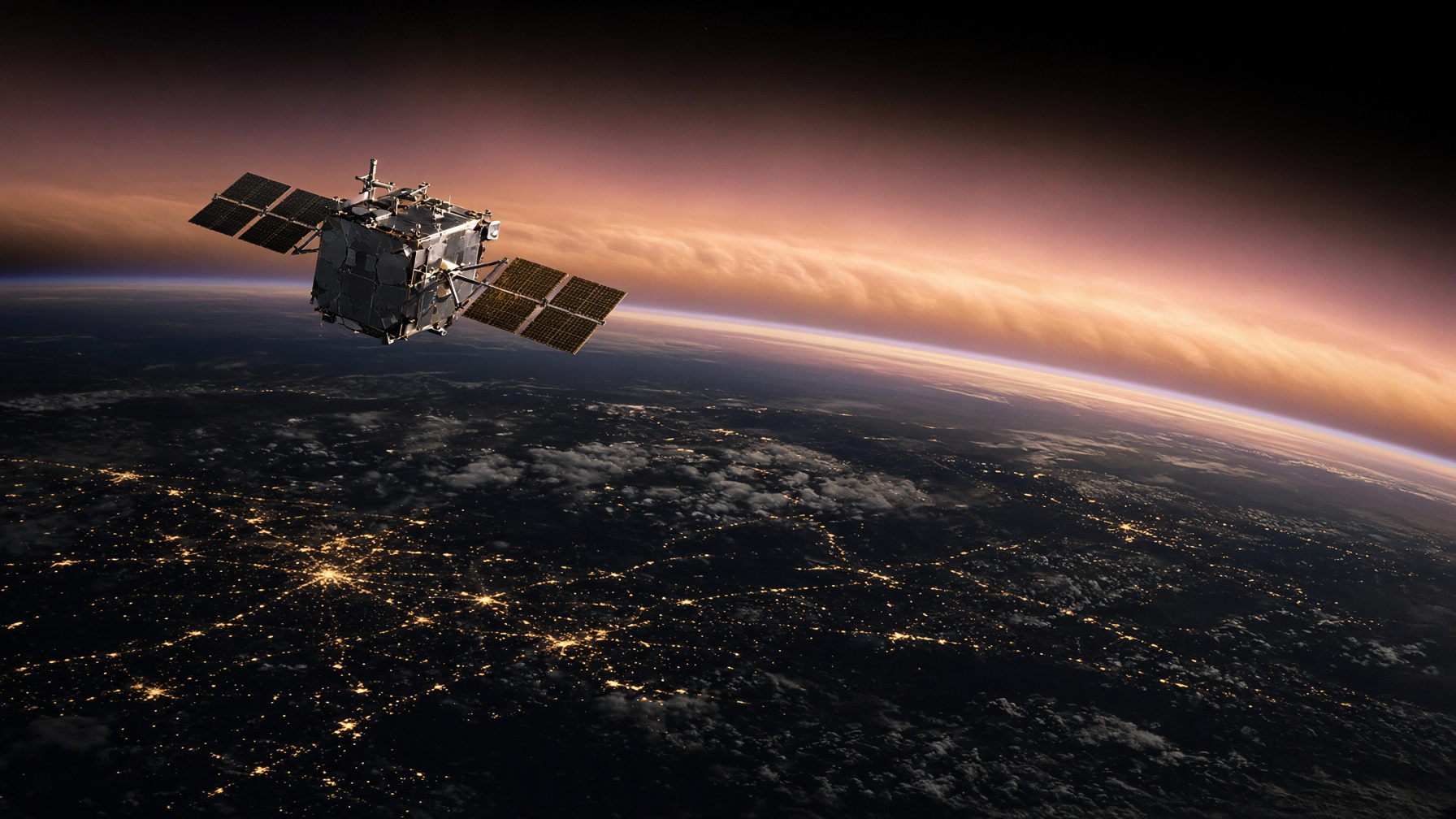
Geomagnetic storms heat the upper atmosphere. Satellites in low orbit feel more drag, and the models that prevent collisions get worse exactly when operators are busy. Constellations that carry communications and imaging are part of the same event as the aurora.
Heating makes the thin air reach higher. A satellite that was flying through almost nothing flies through slightly more, lap after lap. Operators raise orbits when they can. They also spend the storm updating predictions that have become less trustworthy, which is a poor hour to be less trustworthy.
A household will not manage orbital debris. A household might notice that the navigation and messaging it assumes are space services. When those wobble, the paper map is not nostalgia.
Navigation on a phone is a space service with a ground tail: satellites, a receiver, and a map that may live on a server. Messaging that hops through a constellation feels ordinary until that system is busy coping with drag, with the storm’s other effects on spacecraft, or with a ground segment that lost power. Wobble can mean a slow lock or a dropped link. It should not be the only way you know the meeting point.
A paper map does not need a constellation. It also does not update itself when a road is closed. That is acceptable. In the first day you need the route you already knew, drawn in ink, more than you need a live traffic layer.
Storms that are “only” a satellite problem can still scramble the tools emergency managers use to look organized. Expect slower official information, not a conspiracy.
Imaging, timing, and satellite links are how some agencies see a region and talk across it. If those are degraded, the briefing is later and the map is coarser. That lag looks like secrecy if you expected a dashboard. It is often a sky that got harder to use, plus a ground network having its own night.
Sources
- Near Miss: The Solar Superstorm of July 2012 — NASA Science · the article this brief was written from
- NOAA Space Weather Scales — NOAA Space Weather Prediction Center
- Space Weather: Policy and U.S. Government Roles (CRS R46049) — Congressional Research Service
More in CME
- A Carrington-class storm is a when, not a science-fiction if
by: Andrew, Co-Founder at Blackout Briefing
- G2 is a nuisance until it is pointed at the wrong transformer
by: Andrew, Co-Founder at Blackout Briefing
- Quebec, 1989, is still the cleanest warning the grid has
by: Andrew, Co-Founder at Blackout Briefing
Recent news
EMP
The civilian grid is still the soft target in a high-altitude pulseby: Andrew, Co-Founder at Blackout Briefing
Grid
Metcalf still explains the grid better than most white papersby: Andrew, Co-Founder at Blackout Briefing
Survival
The first seventy-two hours are a sequence, not a vibeby: Andrew, Co-Founder at Blackout Briefing