CME · Saturday, October 10
The Carrington Event was two storms, and the second one mattered
September 1859 was not a single blink. The sun hit, and then hit again while the system was already disturbed.
by: Andrew, Co-Founder at Blackout Briefing
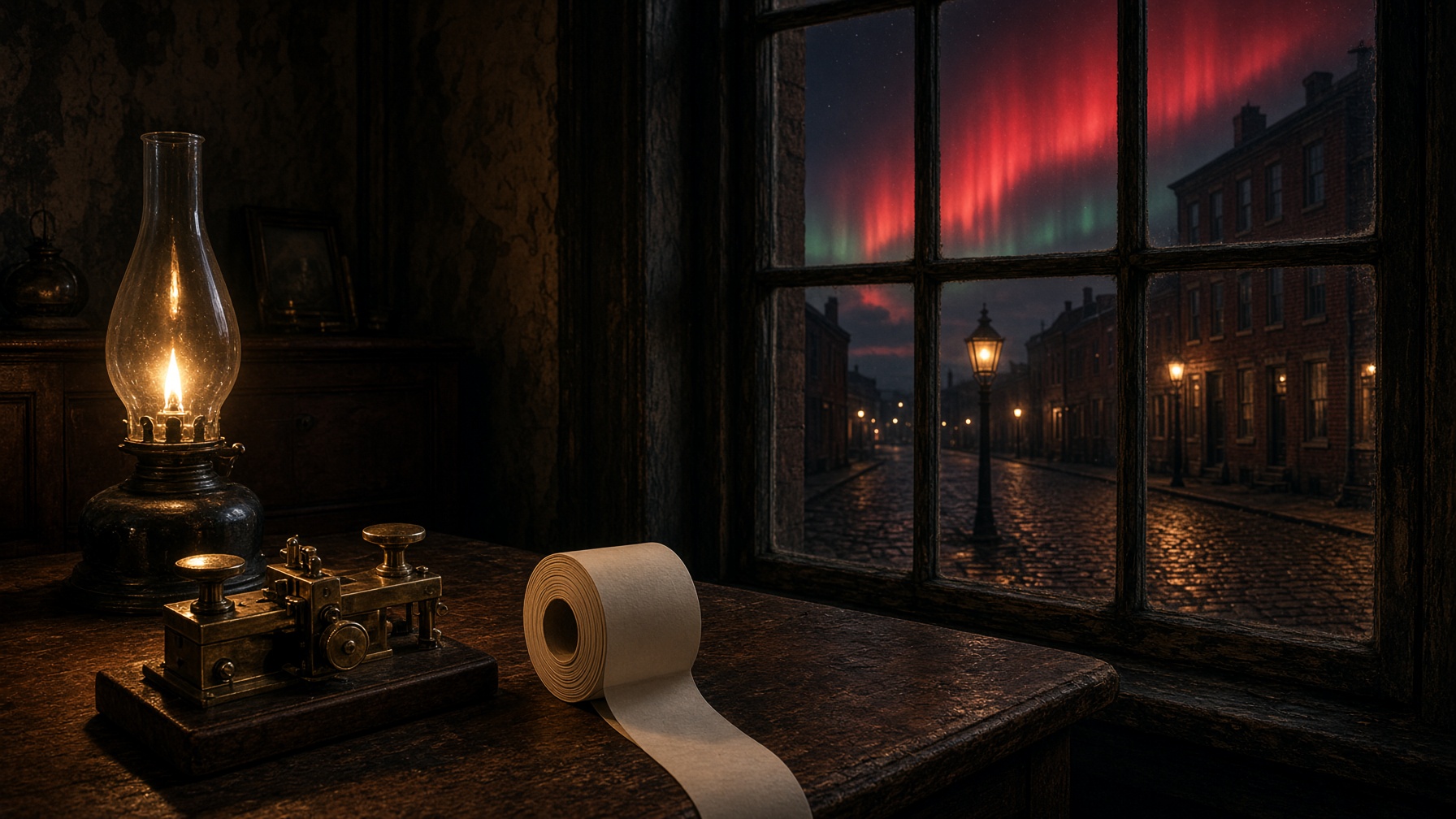
Richard Carrington saw a white-light flare on September 1, 1859. The geomagnetic storm that followed was enormous, and a second structure arrived while Earth’s field was still ringing. Telegraph systems failed across continents. Auroras were reported in the Caribbean.
Telegraph lines were the long conductors of that century, and they were the machines the storm had available. The reported failures were not a local curiosity. They showed up across widely separated systems. The physical point has not changed: a field that couples into long wires. What has changed is what those wires are attached to.
The flare was the marker on the calendar. The storm was what coupled into the ground. Auroras far south of the usual latitudes are why the Caribbean appears in the retelling. The shape is enough: a solar event, a field already disturbed, and then more.
Compound events are the version modern planners lose sleep over: a grid already stressed by heat or by the first shock, then a second CME. Models that assume a clean, isolated storm are the optimistic case.
A second arrival matters because the first has already spent the margin. Operators are tired. A unit that rode through once is hotter than it was that morning. A heat wave does the same favor if the storm shows up in a peak-load week. The optimistic model resets the system to a calm day between punches. The sun is not required to provide the reset.
Two storms is the plain version of a compound event. The stack can also be a storm on top of an ordinary outage, a fire-weather shutoff, or a region already short of transformers for peacetime reasons. The 1859 sequence is the historical picture that makes the stacking easy to see. The stacking is the part planners are actually afraid of.
You cannot time your pantry to a double hit. You can refuse to be at zero water because the first watch “wasn’t that bad.”
The first watch that fizzles, or that hits and seems survivable, is how a household talks itself into emptying the jugs and skipping the next charge. Leave the margin in place until the active period is actually over. You are not timing the sun. You are refusing to spend the buffer on the relief after round one.
Sources
- The Carrington Event: History's greatest solar storm — Space.com · the article this brief was written from
- NOAA Space Weather Scales — NOAA Space Weather Prediction Center
- Space Weather: Policy and U.S. Government Roles (CRS R46049) — Congressional Research Service
More in CME
- A Carrington-class storm is a when, not a science-fiction if
by: Andrew, Co-Founder at Blackout Briefing
- G2 is a nuisance until it is pointed at the wrong transformer
by: Andrew, Co-Founder at Blackout Briefing
- Quebec, 1989, is still the cleanest warning the grid has
by: Andrew, Co-Founder at Blackout Briefing
Recent news
EMP
The civilian grid is still the soft target in a high-altitude pulseby: Andrew, Co-Founder at Blackout Briefing
Grid
Metcalf still explains the grid better than most white papersby: Andrew, Co-Founder at Blackout Briefing
Survival
The first seventy-two hours are a sequence, not a vibeby: Andrew, Co-Founder at Blackout Briefing