CME · Tuesday, October 13
The ground under the line is part of the circuit
Resistive rock makes a worse geomagnetic storm. Utilities cannot move the bedrock. They can move the procedures.
by: Andrew, Co-Founder at Blackout Briefing
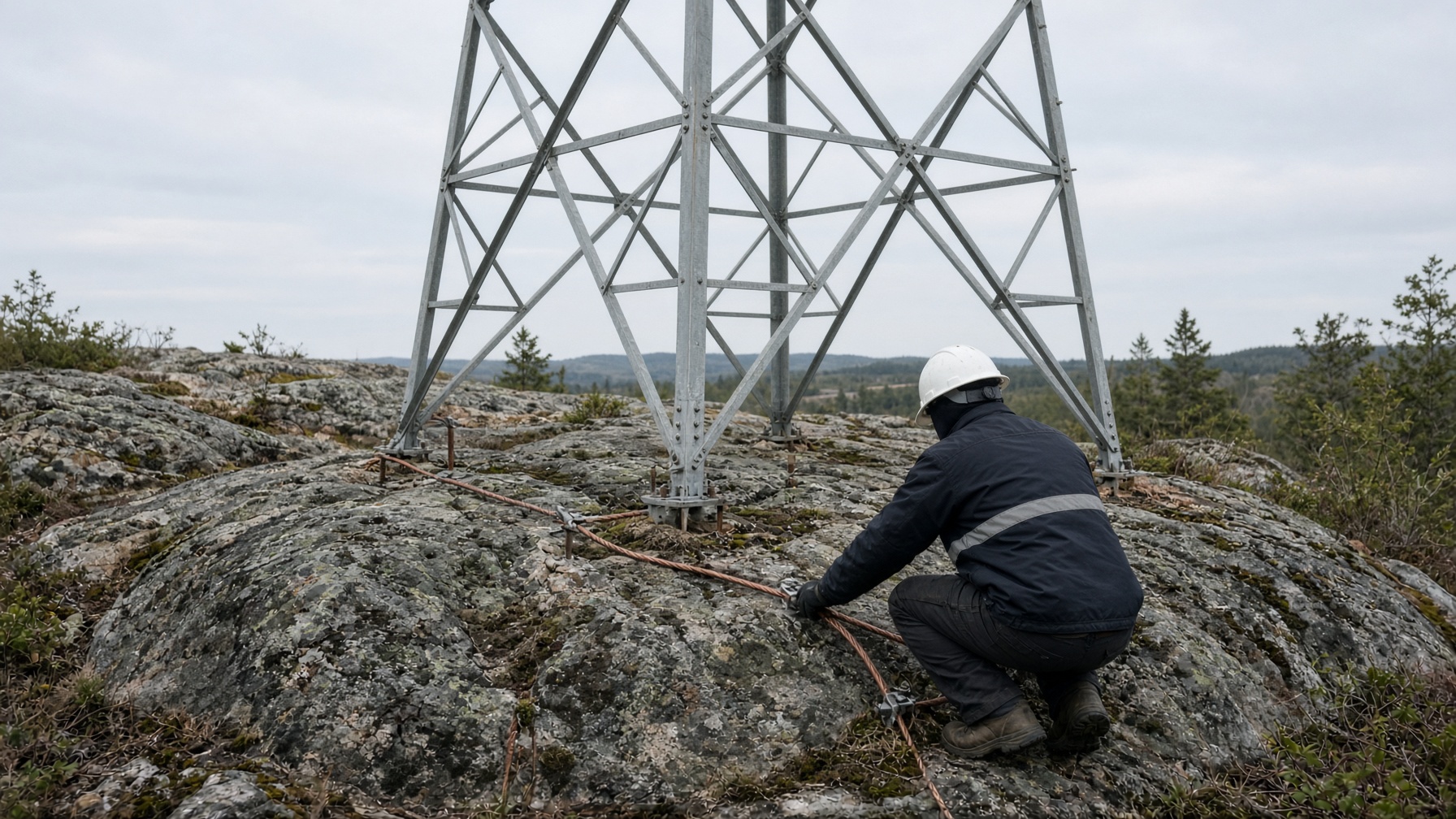
Geomagnetically induced current depends on geology. Igneous rock forces more current into the wires; deep conductive sediment gives it an easier path through the earth. Two utilities at the same latitude can face different storms from the same CME.
The electric field is impressed across the ground. Where the earth conducts well, more of the current stays in the soil. Where the rock is resistive, the wires above it become the easier path. Orientation matters too: a long line pointed along the field collects more than a short line pointed across it.
That is why national averages under-prepare the unlucky corridor and over-alarm the lucky one. Good planning is local: which substations, which orientation, which units run hot in the model.
A corridor of old rock under a set of long, high-voltage lines is a different problem from a utility sitting on deep sediment, even in the same watch box on a national map. The watch is still real for both. The current they should expect is not.
Models are only as honest as the geology and the network data fed into them. A utility that has never put its own ground into the study is borrowing someone else’s storm. The units that run hot are often not the ones a person would guess from a highway view of the substation.
Readers do not need the conductivity map. They need a utility that has one and is willing to say so.
Willing to say so means a plain sentence: we have looked at our ground, these stations are the ones we watch, here is what we do when a severe warning is issued. It does not mean posting a sensitive diagram. It means the planning is local enough that a national headline is not their only procedure.
Sources
- March 1989 geomagnetic storm — Public record of the Hydro-Québec collapse · the article this brief was written from
- NOAA Space Weather Scales — NOAA Space Weather Prediction Center
- Space Weather: Policy and U.S. Government Roles (CRS R46049) — Congressional Research Service
More in CME
- A Carrington-class storm is a when, not a science-fiction if
by: Andrew, Co-Founder at Blackout Briefing
- G2 is a nuisance until it is pointed at the wrong transformer
by: Andrew, Co-Founder at Blackout Briefing
- Quebec, 1989, is still the cleanest warning the grid has
by: Andrew, Co-Founder at Blackout Briefing
Recent news
EMP
The civilian grid is still the soft target in a high-altitude pulseby: Andrew, Co-Founder at Blackout Briefing
Grid
Metcalf still explains the grid better than most white papersby: Andrew, Co-Founder at Blackout Briefing
Survival
The first seventy-two hours are a sequence, not a vibeby: Andrew, Co-Founder at Blackout Briefing