Grid · Friday, October 16
Distribution lines are long. The scarce part is still the big transformer.
The United States has millions of miles of wire and a much smaller set of extra-high-voltage units that everything upstream depends on.
by: Andrew, Co-Founder at Blackout Briefing
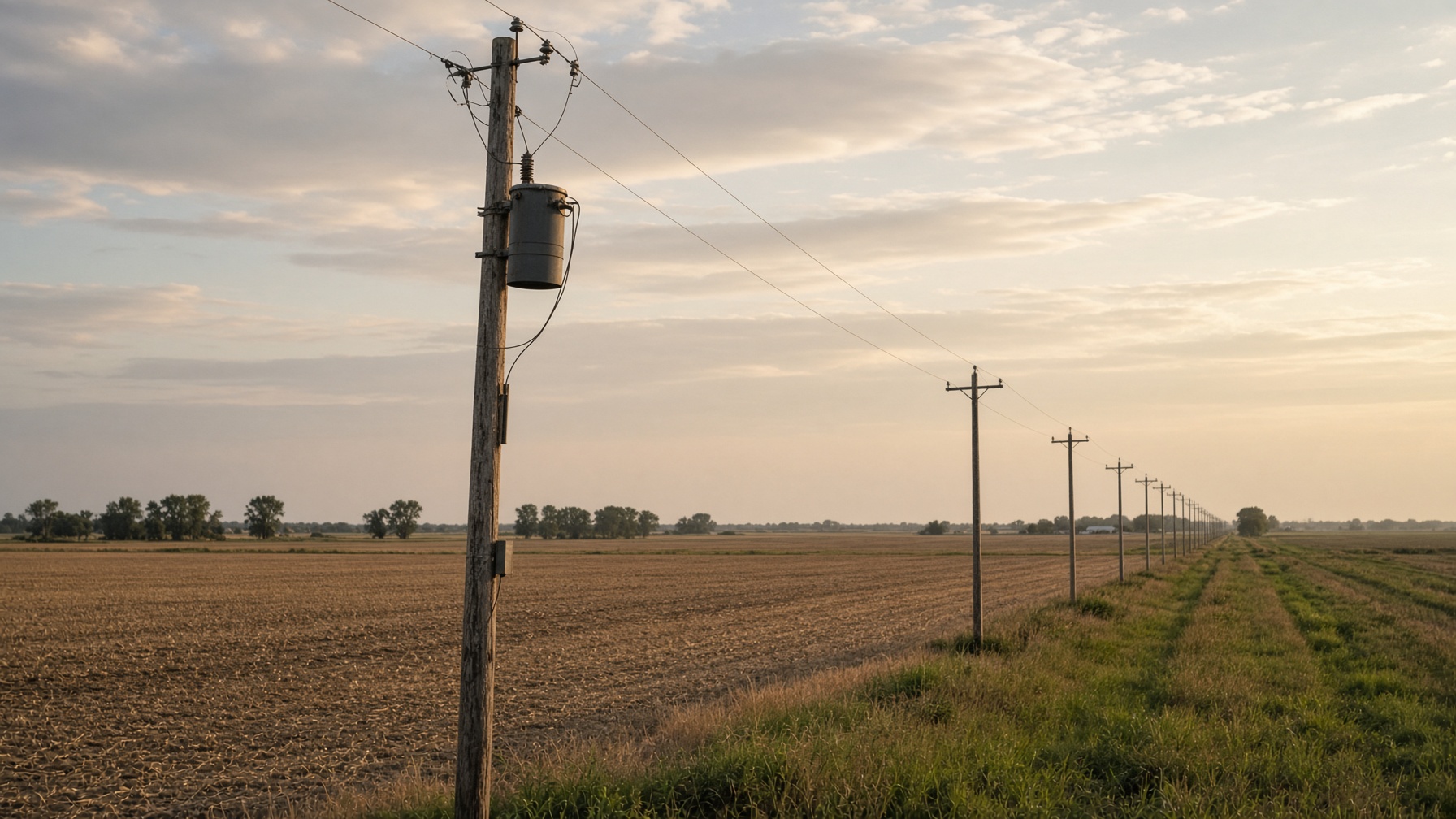
Outage maps train people to think in downed spans and bucket trucks. Those crews are good at weather. They are not good at manufacturing a 345-kilovolt transformer in a parking lot. The units that tie regions together are few, heavy, and slow.
Weather restoration has a grammar people know because they can see it: spans down, trucks out, a map that clears. Crews are good at that work. They cannot machine a large transformer in a parking lot. The units that tie regions together are few, they are heavy enough that roads and rail become part of the repair, and they are slow because the clock starts at a factory.
Aging makes the arithmetic worse. A large share of transmission equipment is already past the age it was designed around. A storm or an attack does not have to destroy everything. It has to destroy the units nobody can borrow from next door because next door needs them too.
A large share of transmission equipment is already older than the age it was designed around. That is not a prophecy that it fails on a birthday. Equipment outlives its original plan with maintenance and luck. Age still means less slack: fewer obvious donors, and a fleet that was not built to be replaced in a single season.
Spare-transformer programs exist. They are not sized for a continent-wide bad day. That gap is the entire policy argument in one sentence.
Borrowing is the spare system the industry already uses, and it assumes the bad day is local. A neighbor can loan a unit when the neighbor is intact. A storm or an attack that hits many owners at once turns every neighbor into a buyer. The loan does not clear. What remains is the queue nobody sized for a continent-wide day.
Spare-transformer programs are the right idea at the wrong scale if they cannot cover a correlated bad day. That single gap is the policy argument. Outage maps will keep showing distribution lines, because that is what people see. The length of the outage will still be set by the scarce bulk units the map does not draw.
Sources
- Evaluation of the Physical Security Reliability Standard and Physical Attacks on the Bulk-Power System — Federal Energy Regulatory Commission · the article this brief was written from
- Electromagnetic Pulse and Geomagnetic Disturbance — Cybersecurity and Infrastructure Security Agency
More in Grid
- Metcalf still explains the grid better than most white papers
by: Andrew, Co-Founder at Blackout Briefing
- San Antonio’s hardening pilot is a template, not a finish line
by: Andrew, Co-Founder at Blackout Briefing
- Inverter-based resources changed where the grid can break
by: Andrew, Co-Founder at Blackout Briefing
Recent news
EMP
The civilian grid is still the soft target in a high-altitude pulseby: Andrew, Co-Founder at Blackout Briefing
CME
A Carrington-class storm is a when, not a science-fiction ifby: Andrew, Co-Founder at Blackout Briefing
Survival
The first seventy-two hours are a sequence, not a vibeby: Andrew, Co-Founder at Blackout Briefing