Grid · Sunday, October 18
Inverter-based resources changed where the grid can break
Solar, wind, and batteries moved electronics into the open, outside the buildings that used to shield controls.
by: Andrew, Co-Founder at Blackout Briefing
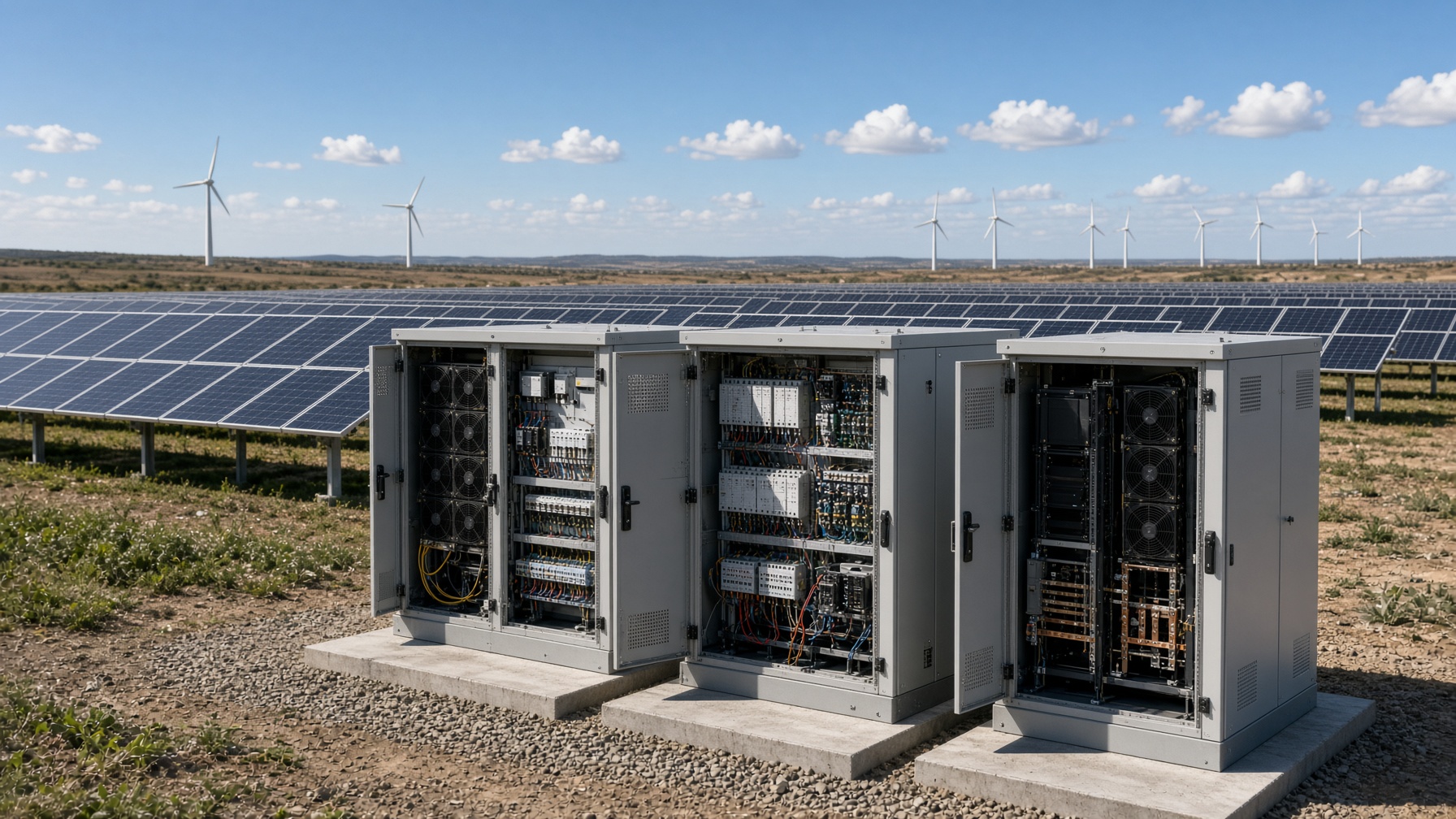
Oak Ridge and other labs have been blunt about a new exposure. A growing share of generation sits in fields and on roofs as inverter-based resources: photovoltaics, wind, batteries. The power electronics that make them useful are also the parts a fast electromagnetic field is good at upsetting.
An inverter takes what panels, turbines, or batteries produce and makes it usable by the grid the country already has. The work is done in power electronics, not in a heavy spinning machine. Those parts are the ones a fast field couples into easily. The exposure is the box that translates the resource, not the sun or the wind.
Older spinning generators live inside plants with metal walls and decades of surge practice. A string inverter on a rack does not. The research does not say every solar farm dies in a pulse. It says the industry has less test data on the new fleet than on the old one, exactly as the new fleet becomes load-bearing.
Metal walls and decades of surge practice were not sold as a master shield. They are still a real difference: a building, a grounding scheme, and a pile of lessons from older plants. A string inverter on a rack has the sky and a shorter history. The research gap is that mismatch, growing at the same time the new fleet becomes load-bearing.
For homeowners the translation is modest. A rooftop array is not a magic backup if its inverter and the house panel are both dead. Backup that works in a blackout is the backup you have islanded and tested.
Less test data is not a claim that every plant fails. Some equipment will ride through, some will trip and return, and some will need parts from the same long supply chains as everything else electronic. What the labs are refusing is the assumption that the old fleet’s experience automatically covers the new one. Tests belong before the day, not in the after-action paragraph.
Islanded means a system can carry a chosen load while safely disconnected from a dead or damaged line. Tested means you have watched it do that when a failure was only inconvenient. A rooftop array whose inverter is dead is a roof. If you have not seen the backup run the load you care about, it is not yet the backup in the plan.
Sources
- Vulnerability of Power Generation Critical Systems Against Electromagnetic Threats — Oak Ridge National Laboratory / OSTI · the article this brief was written from
- Evaluation of the Physical Security Reliability Standard and Physical Attacks on the Bulk-Power System — Federal Energy Regulatory Commission
- Electromagnetic Pulse and Geomagnetic Disturbance — Cybersecurity and Infrastructure Security Agency
More in Grid
- Metcalf still explains the grid better than most white papers
by: Andrew, Co-Founder at Blackout Briefing
- San Antonio’s hardening pilot is a template, not a finish line
by: Andrew, Co-Founder at Blackout Briefing
- Volt Typhoon is the cyber version of pre-positioning
by: Andrew, Co-Founder at Blackout Briefing
Recent news
EMP
The civilian grid is still the soft target in a high-altitude pulseby: Andrew, Co-Founder at Blackout Briefing
CME
A Carrington-class storm is a when, not a science-fiction ifby: Andrew, Co-Founder at Blackout Briefing
Survival
The first seventy-two hours are a sequence, not a vibeby: Andrew, Co-Founder at Blackout Briefing