EMP · Monday, October 19
E1, E2, and E3 are not the same problem wearing three names
Surge strips handle one slice of a nuclear pulse. They do not handle the slow current that cooks transformers.
by: Andrew, Co-Founder at Blackout Briefing
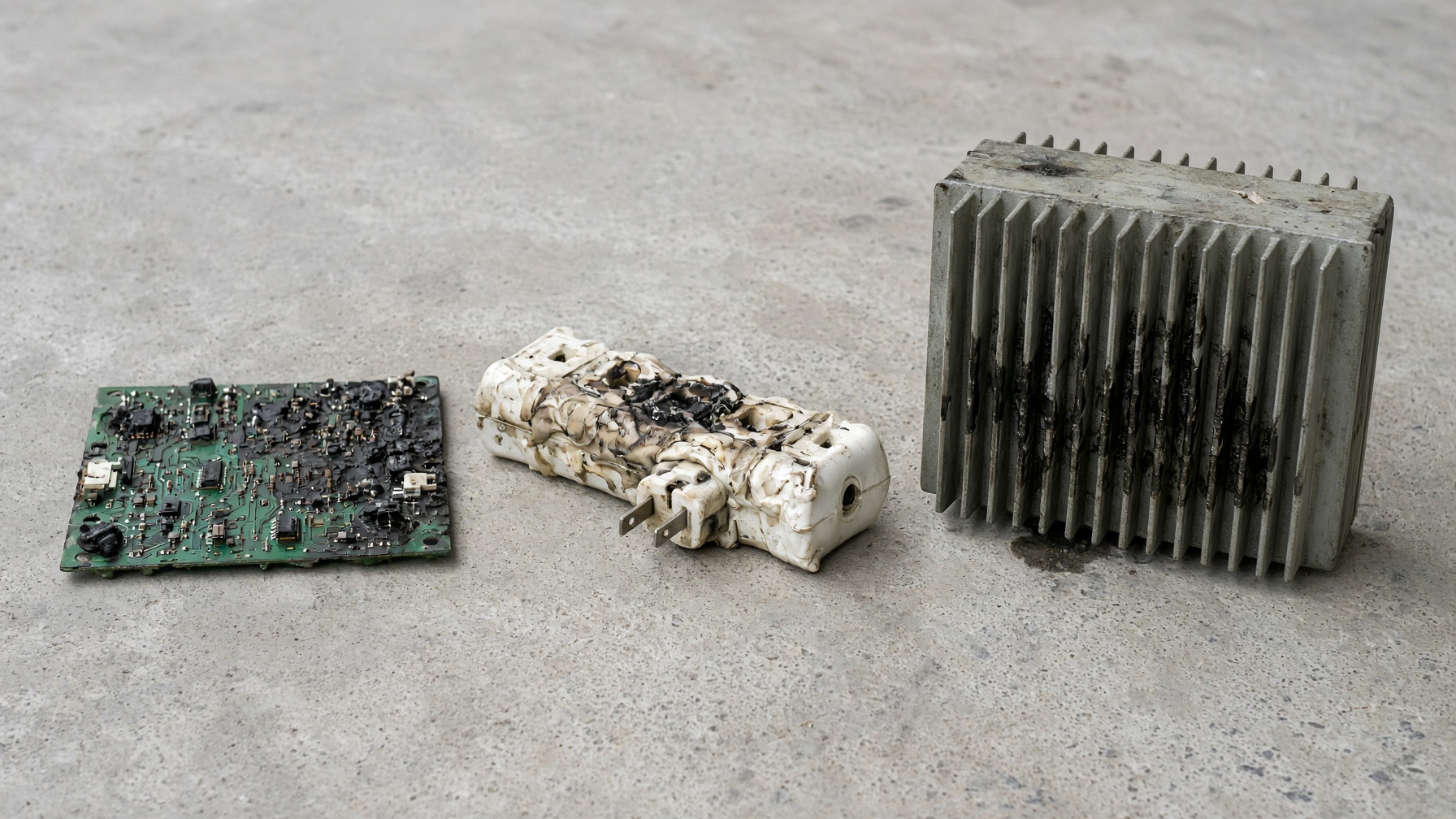
Engineers split a high-altitude nuclear electromagnetic pulse into three rough time scales. E1 is a fast, intense field that can upset or burn electronics. E2 looks, electrically, a lot like lightning. E3 is slow, like a geomagnetic storm, and it is the component that drives damaging current through the transmission grid.
The three names are three couplings. A fast, intense field finds small conductors: boards, control cables, the electronics in an inverter or a vehicle. A slow heave finds the longest conductors already built, the lines that move power. One burst, different victims, different repairs. Treating the letters as synonyms is how the wrong fix gets bought.
That split is why a drawer full of surge protectors is not a national plan and also not useless. E2 is the part ordinary lightning practice already respects. E1 is why unprotected microelectronics — inverters, controllers, vehicle modules — are a separate worry. E3 is why the argument always comes back to transformers and operating procedures.
A surge protector lives at the end of a cord. It is built for insults a building outlet already sees, which is why it is not useless against the slice that resembles lightning. It does not carry away current that miles of transmission line are collecting. Assigning it that job is how a household gadget gets mistaken for a grid plan.
Households and grid planners should stop using “EMP” as a single switch. The protection that matters depends on which part of the pulse you are actually trying to survive.
Procedures are the E3 tool that does not look like a product. Unloading a vulnerable transformer, or taking it offline before the slow current arrives, is a decision with a clock. Shielding and spares still matter for the fast damage. They do not replace a rule that says who may make the slow-current call.
“Survive” is three different outcomes. A radio survives if it still turns on. A substation survives if the transformer is not ruined and the operators still have a procedure. A city survives if water and a shared picture of the outage outlast the event. Protection only makes sense once you say which of those you mean.
Sources
- Electromagnetic Pulse and Geomagnetic Disturbance — Cybersecurity and Infrastructure Security Agency · the article this brief was written from
- Executive Order 13865 — Coordinating National Resilience to Electromagnetic Pulses — The American Presidency Project
- Coordinating National Resilience to Electromagnetic Pulses — Federal Register
More in EMP
- The civilian grid is still the soft target in a high-altitude pulse
by: Andrew, Co-Founder at Blackout Briefing
- Congress keeps using the phrase blackout warfare. The hardware has not caught up.
by: Andrew, Co-Founder at Blackout Briefing
- High-power microwaves are a battlefield tool. They are not a national blackout.
by: Andrew, Co-Founder at Blackout Briefing
Recent news
CME
A Carrington-class storm is a when, not a science-fiction ifby: Andrew, Co-Founder at Blackout Briefing
Grid
Metcalf still explains the grid better than most white papersby: Andrew, Co-Founder at Blackout Briefing
Survival
The first seventy-two hours are a sequence, not a vibeby: Andrew, Co-Founder at Blackout Briefing