Grid · Thursday, October 8
Islanding a house is a project, not a power strip
Backfeed kills lineworkers. A transfer switch is the adult way to own a generator.
by: Andrew, Co-Founder at Blackout Briefing
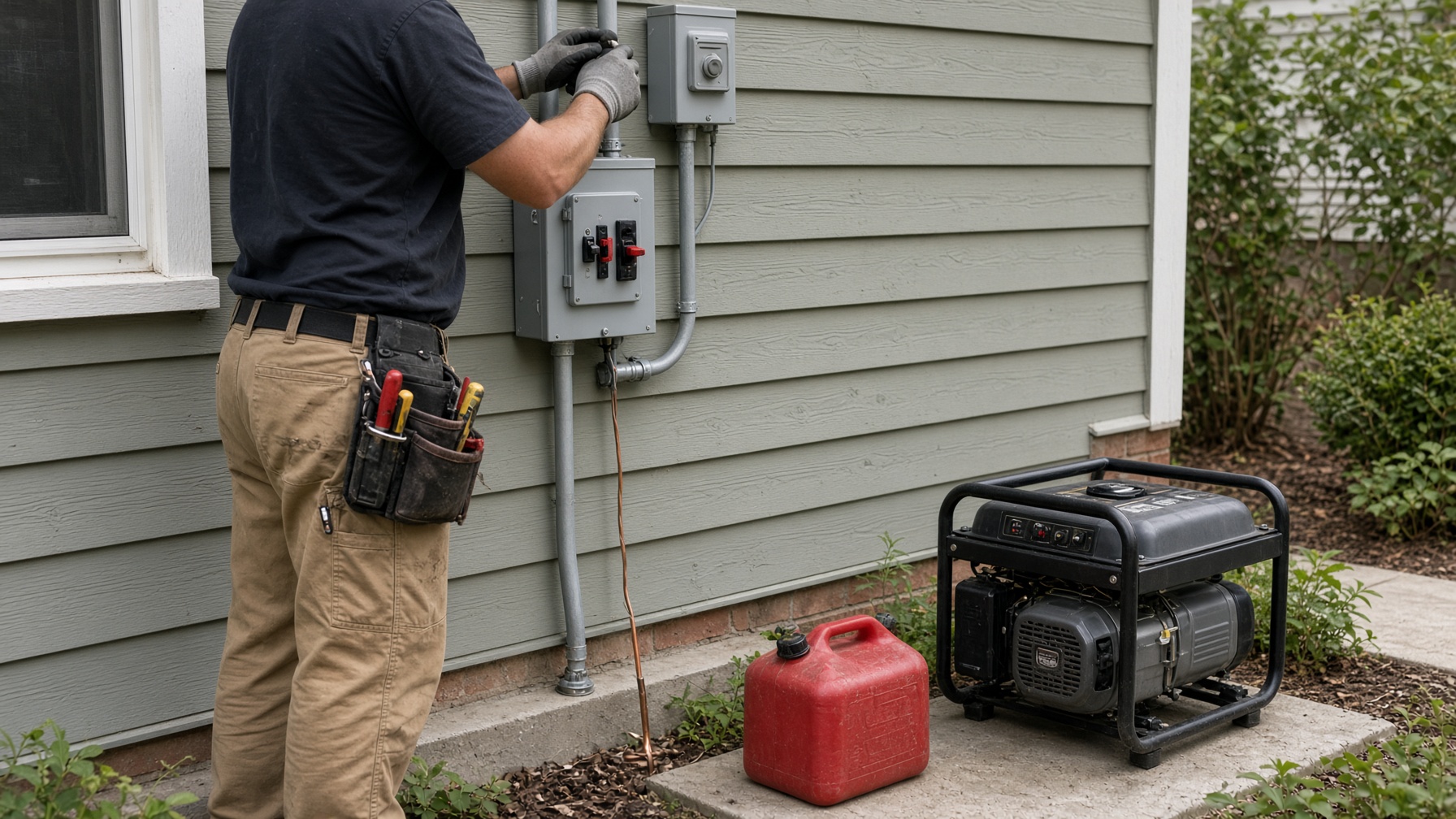
Plugging a generator into a dryer outlet can energize the line outside and kill someone trying to restore it. The legal and moral fix is a transfer switch or interlock, installed by someone who will still take your call. It also keeps you from backfeeding your own electronics in creative ways.
An interlock will not let the generator breaker and the utility breaker be closed together. A transfer switch moves the house, or a chosen set of circuits, from one source to the other. Both exist so a line crew sees a dead line. A cord in a dryer outlet does not do that job.
The installer who will still take your call is the one who pulled a permit and owns the work. The machine itself belongs outside, where its exhaust is not being invited into a window. If the only instructions in the house came from the lot where you bought it, you have a purchase, not an installation.
Critical-load panels — a small set of circuits for the fridge, the furnace blower, a few lights — make limited fuel useful. Whole-house backup is a different budget and a different fuel problem.
What stays off that small panel is the load that turns a day of fuel into an hour: the range, the dryer, resistance heat, the extra refrigerator in the garage. Write the list before the outage. Choosing while the machine is running is how the tank empties with every light in the house still on.
A manual switch means a person has to be home and has to know the order: the generator running and behaving, then the transfer, never both sources tied together. That sequence is the whole household skill. The first time it is read should not be by flashlight.
Test it on a Saturday. A switch you have never thrown is a rumor. Throw it onto the real critical loads, not an empty panel, and see what runs and what an hour does to the fuel. Put that sequence on a card beside the switch.
Sources
- Securing Against Possible Electromagnetic Pulse Attacks — AFCEA International · the article this brief was written from
- Evaluation of the Physical Security Reliability Standard and Physical Attacks on the Bulk-Power System — Federal Energy Regulatory Commission
- Electromagnetic Pulse and Geomagnetic Disturbance — Cybersecurity and Infrastructure Security Agency
More in Grid
- Metcalf still explains the grid better than most white papers
by: Andrew, Co-Founder at Blackout Briefing
- San Antonio’s hardening pilot is a template, not a finish line
by: Andrew, Co-Founder at Blackout Briefing
- Inverter-based resources changed where the grid can break
by: Andrew, Co-Founder at Blackout Briefing
Recent news
EMP
The civilian grid is still the soft target in a high-altitude pulseby: Andrew, Co-Founder at Blackout Briefing
CME
A Carrington-class storm is a when, not a science-fiction ifby: Andrew, Co-Founder at Blackout Briefing
Survival
The first seventy-two hours are a sequence, not a vibeby: Andrew, Co-Founder at Blackout Briefing