Grid · Wednesday, October 14
Mutual aid works for hurricanes. It works poorly for a shared scar.
Crews and spare poles travel well. Spare extra-high-voltage transformers do not, especially if every neighbor needs one.
by: Andrew, Co-Founder at Blackout Briefing
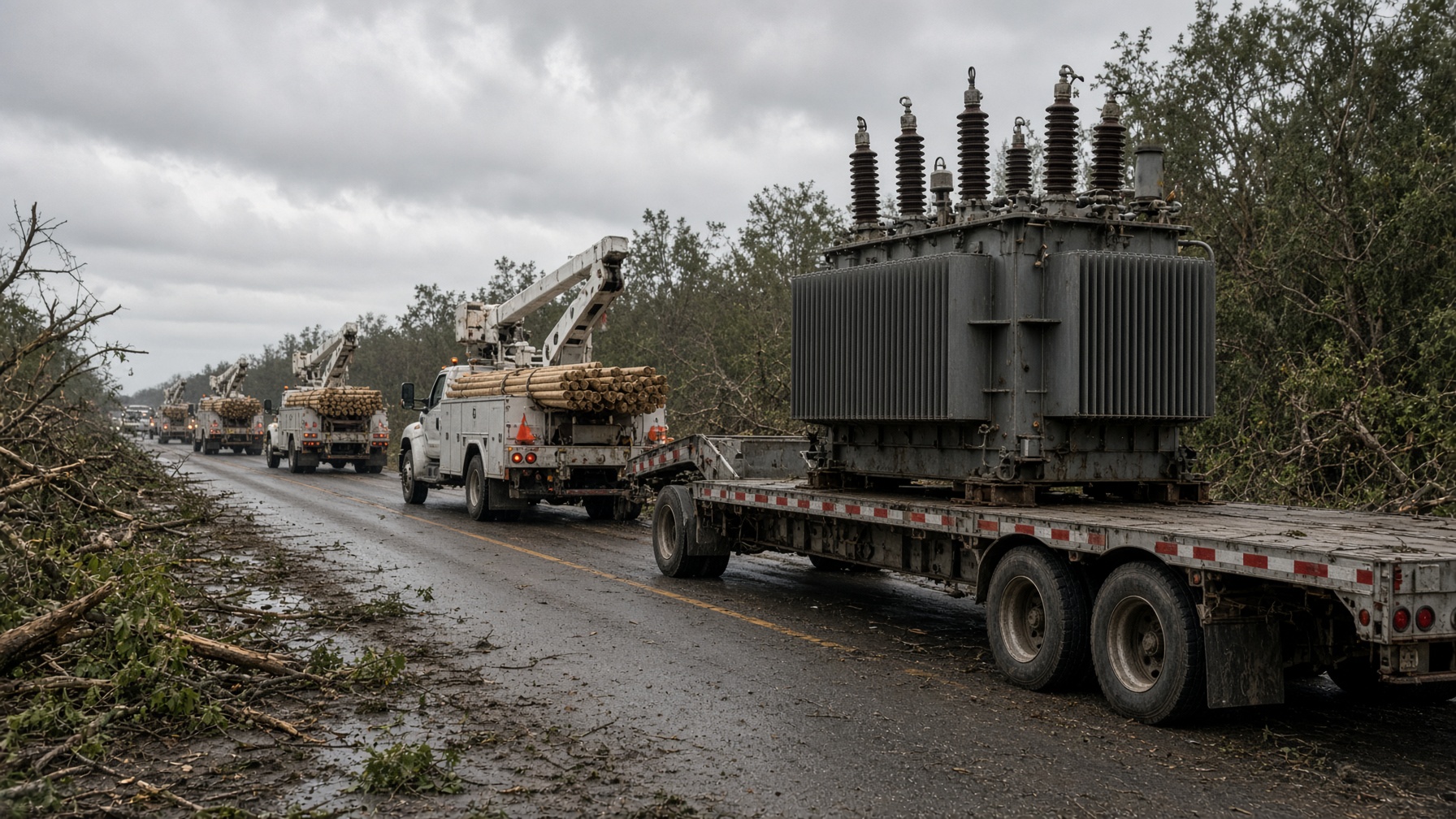
U.S. utilities have a deep culture of mutual aid. After a hurricane, trucks roll in from states that still have power. That system is a genuine achievement, and it depends on the damage being local and the replacement parts being ordinary.
The trucks carry crews, poles, wire, and the ordinary hardware of a distribution system. A neighboring utility can spare those things because the hurricane did not hit its own yards. The bargain is simple: this season you help me, next season I help you, and both of us still have a system left standing.
A geomagnetic storm or a wide electromagnetic insult breaks the assumption. The damage mechanism hits many regions at once, and the scarce part is not linemen. It is equipment that was already on a long lead time when times were calm.
An extra-high-voltage transformer is not a pole. It is a large, often custom machine, built to a specification, moved on a special trailer, and installed on a pad that was engineered for it. When several regions need the same class of unit, the mutual-aid roster still answers the phone. It just does not have the part in the truck.
That is the shared scar. A hurricane leaves a clean edge: damaged here, intact there. A continent-scale insult smudges the edge. The utility that would have sent the spare is checking its own neutral currents, its own hot units, its own lead times.
Regional spare pools are the grown-up version of mutual aid for this threat. They are also expensive, which is why they remain thinner than the speeches.
A pool only works if the machines in it match the units that failed, if the transport still runs, and if the agreement about who draws first was written before the week got loud. None of that is a speech. It is a warehouse, a trailer, and a contract.
Sources
- Evaluation of the Physical Security Reliability Standard and Physical Attacks on the Bulk-Power System — Federal Energy Regulatory Commission · the article this brief was written from
- Electromagnetic Pulse and Geomagnetic Disturbance — Cybersecurity and Infrastructure Security Agency
More in Grid
- Metcalf still explains the grid better than most white papers
by: Andrew, Co-Founder at Blackout Briefing
- San Antonio’s hardening pilot is a template, not a finish line
by: Andrew, Co-Founder at Blackout Briefing
- Inverter-based resources changed where the grid can break
by: Andrew, Co-Founder at Blackout Briefing
Recent news
EMP
The civilian grid is still the soft target in a high-altitude pulseby: Andrew, Co-Founder at Blackout Briefing
CME
A Carrington-class storm is a when, not a science-fiction ifby: Andrew, Co-Founder at Blackout Briefing
Survival
The first seventy-two hours are a sequence, not a vibeby: Andrew, Co-Founder at Blackout Briefing