Grid · Sunday, October 11
Reactive power is the part of the grid nobody explains until it is gone
Transformers that saturate do not just heat. They stop supporting voltage.
by: Andrew, Co-Founder at Blackout Briefing
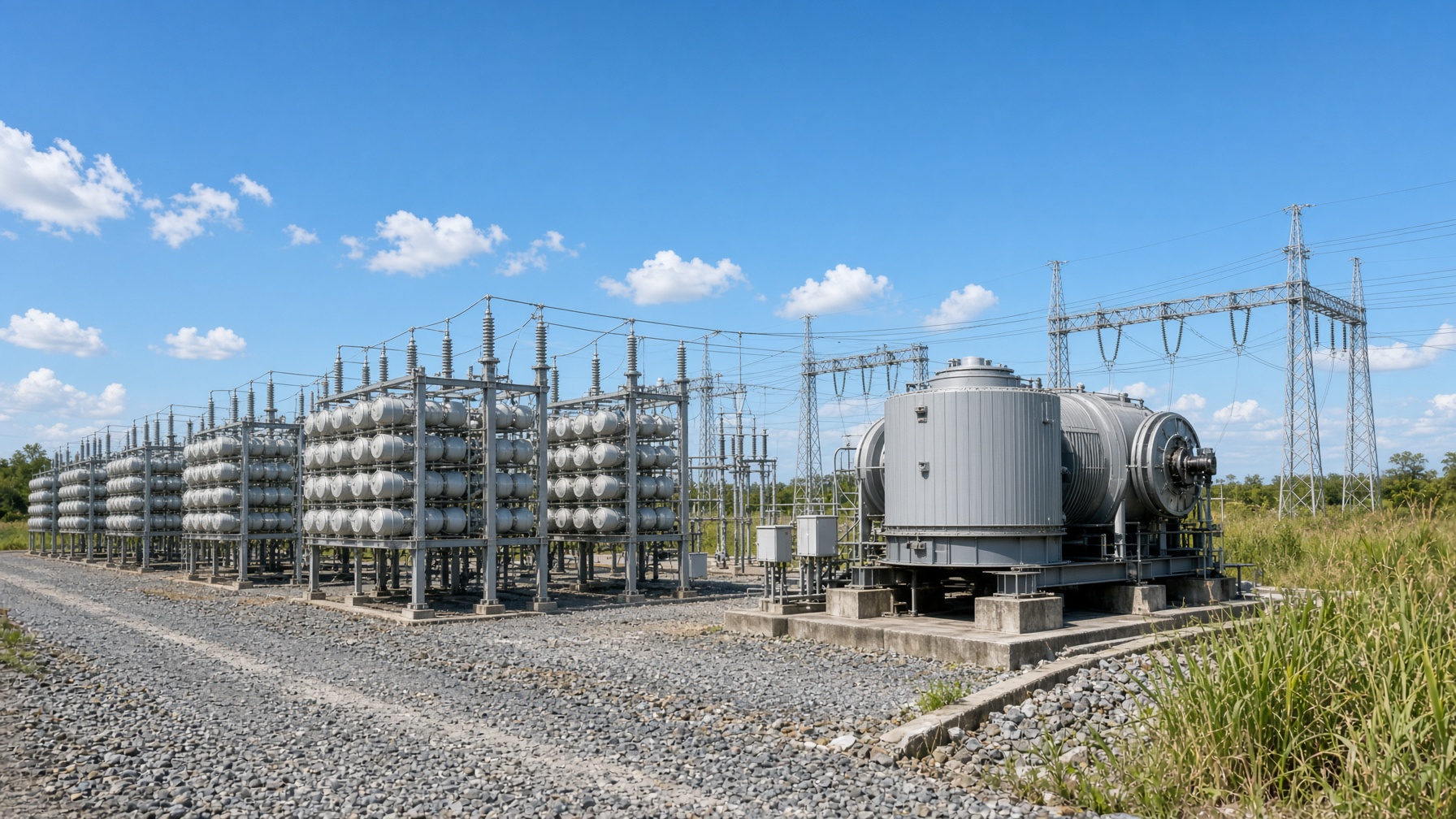
Half-cycle saturation in a transformer, the classic geomagnetic failure mode, burns energy as heat and injects harmonics. It also soaks up reactive power, which is the unglamorous product that keeps voltage standing up. A system can look like it has enough real power and still collapse because voltage support vanished.
Real power is the part you can picture: it turns motors and lights lamps. Reactive power is the part that holds voltage up so the real power can do its work. When saturated transformers drink it, the system can be rich in generation and poor in voltage at the same time. Operators watch that gap. It is not a technicality.
That is why the symptom can be widespread and weird rather than one exploded building: alarms, trips, voltage excursions, then a cascade. It is also why “we have plenty of generation” is not a complete answer to a solar-storm question.
A cascade in this mode does not require a single dramatic failure on camera. Voltage sags, a line trips, the remaining network takes more stress, another protection scheme decides it has seen enough. From the outside it can look like the grid quit for no reason. From the control room it looked like a support problem that got ahead of them.
Harmonics are the other half of the same saturation. They heat equipment and they can confuse relays that were tuned for cleaner waveforms. The event can present as heat, as a trip, and as a voltage problem in the same hour. None of those requires the utility to be out of fuel.
You do not need to run the power-flow study. You need to believe the operator who says the problem is voltage, not fuel.
Belief, here, is practical. If the instruction is to reduce load, or to expect outages while they put voltage back together, the instruction is not a confession that someone forgot to buy fuel. It is the public edge of a problem you will not see from the meter. Arguing from a headline about spare generation misses the product that actually ran out.
Sources
- Evaluation of the Physical Security Reliability Standard and Physical Attacks on the Bulk-Power System — Federal Energy Regulatory Commission · the article this brief was written from
- Electromagnetic Pulse and Geomagnetic Disturbance — Cybersecurity and Infrastructure Security Agency
More in Grid
- Metcalf still explains the grid better than most white papers
by: Andrew, Co-Founder at Blackout Briefing
- San Antonio’s hardening pilot is a template, not a finish line
by: Andrew, Co-Founder at Blackout Briefing
- Inverter-based resources changed where the grid can break
by: Andrew, Co-Founder at Blackout Briefing
Recent news
EMP
The civilian grid is still the soft target in a high-altitude pulseby: Andrew, Co-Founder at Blackout Briefing
CME
A Carrington-class storm is a when, not a science-fiction ifby: Andrew, Co-Founder at Blackout Briefing
Survival
The first seventy-two hours are a sequence, not a vibeby: Andrew, Co-Founder at Blackout Briefing