EMP · Tuesday, October 13
Testing a system against a pulse is a craft, not a slogan
Simulators, injection tests, and standards exist. Most civilian gear has never seen them.
by: Andrew, Co-Founder at Blackout Briefing
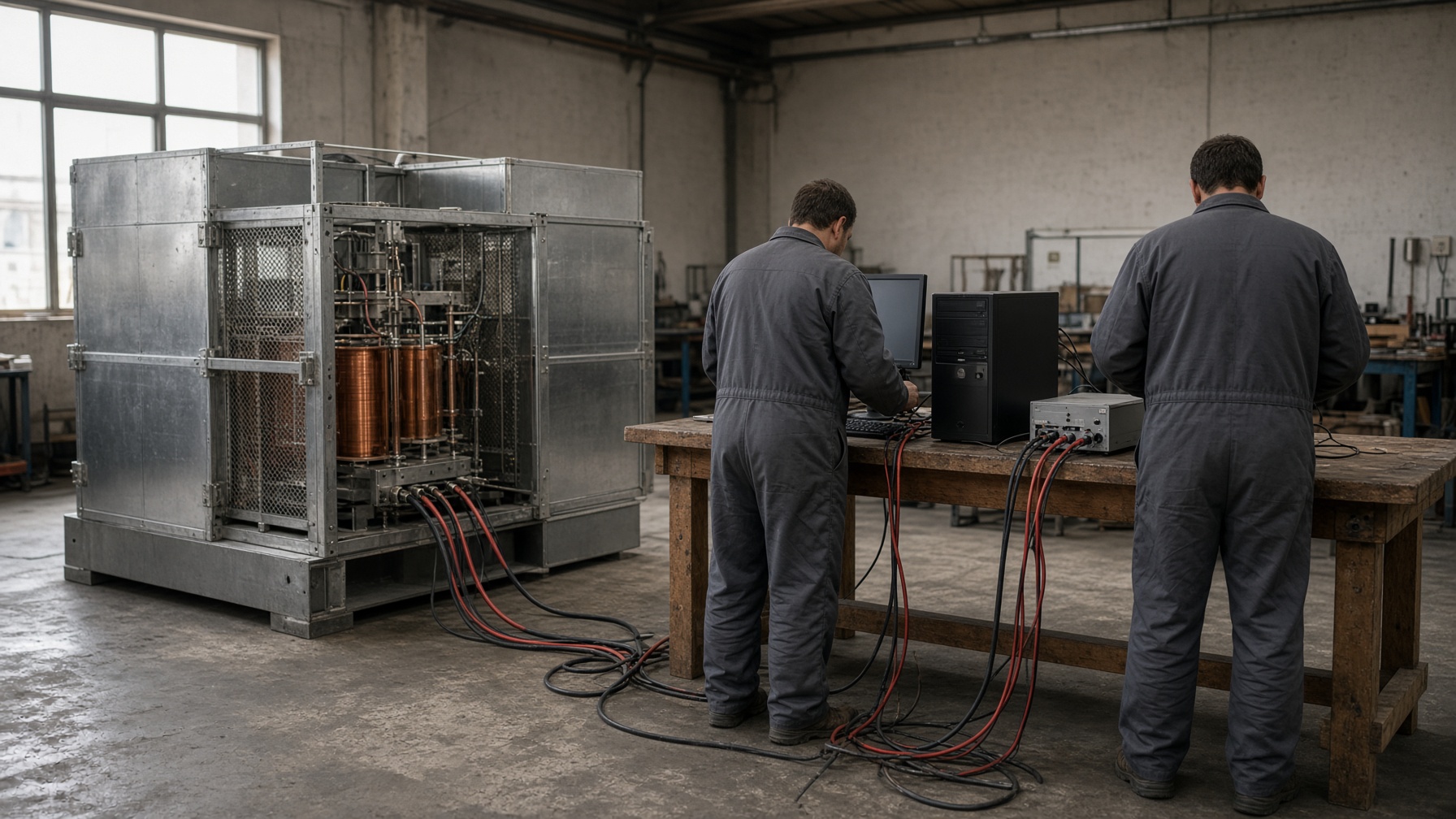
Militaries and a handful of civilian labs test equipment in EMP simulators and with pulsed-current injection. Standards bodies have waveforms for the early, intermediate, and late parts of a high-altitude burst. The work is detailed, expensive, and mostly invisible to people buying a home inverter.
The early part is a fast, sharp field. The intermediate part is closer to a lightning-like surge. The late part is the slow pulse that drives current in long lines, the cousin of a geomagnetic storm. A test that covers one of them says nothing automatic about the other two. That is why “we tested it” is not yet an answer.
Simulators large enough to illuminate a real piece of equipment are rare, booked, and priced like the specialized facilities they are. Injection tests on a port or a cable are more common and still not a weekend project. Most of the civilian market never goes. The inverter on a hardware-store shelf was built to a safety standard for daily use, not to a pulse standard nobody required.
Absence of a test is not proof of fragility, and a marketing line that says “EMP hardened” without a standard and a level is not proof of anything. Ask what waveform, what amplitude, and what failed in the test. If the seller cannot answer, you are buying a mood.
Some untested gear will shrug. Some will not. You cannot know which from the font on the box. A useful answer names a standard, names the level, and says what happened to the device — it worked, it upset and recovered, or it failed. Silence is the tell.
Nationally, the same skepticism belongs on untested claims that the grid is “basically fine.” Fine relative to which waveform?
A grid study that models the late pulse and ignores the fast field, or the reverse, is a partial sentence. So is a vendor brochure. The craft is matching the claim to the part of the event it actually covers, and saying so in words a buyer or a regulator can check.
Sources
- Vulnerability of Power Generation Critical Systems Against Electromagnetic Threats — Oak Ridge National Laboratory / OSTI · the article this brief was written from
- Electromagnetic Pulse and Geomagnetic Disturbance — Cybersecurity and Infrastructure Security Agency
- Executive Order 13865 — Coordinating National Resilience to Electromagnetic Pulses — The American Presidency Project
- Coordinating National Resilience to Electromagnetic Pulses — Federal Register
More in EMP
- The civilian grid is still the soft target in a high-altitude pulse
by: Andrew, Co-Founder at Blackout Briefing
- E1, E2, and E3 are not the same problem wearing three names
by: Andrew, Co-Founder at Blackout Briefing
- Congress keeps using the phrase blackout warfare. The hardware has not caught up.
by: Andrew, Co-Founder at Blackout Briefing
Recent news
CME
A Carrington-class storm is a when, not a science-fiction ifby: Andrew, Co-Founder at Blackout Briefing
Grid
Metcalf still explains the grid better than most white papersby: Andrew, Co-Founder at Blackout Briefing
Survival
The first seventy-two hours are a sequence, not a vibeby: Andrew, Co-Founder at Blackout Briefing